
A biospecimen biobank (biobank) is defined as a facility where biological materials (e.g., serum, pathological specimens, genomic material) from human research subjects are stored for secondary research. The design, operations, material collected, and plans for use and/or sharing for secondary research, determine which regulations apply, the level of IRB review and oversight required.
[D129.0000] Research Biospecimen Biobank Guidance
Establishing a Biospecimen Biobank for Research
IRB Submission of a Biobank Protocol
The IRB is charged with reviewing protocols for collecting, storing, and sharing information, verifying informed consent, and protecting the privacy and confidentiality of human specimens (e.g., blood samples, tissue) for research purposes. To establish a biobank, the Principal Investigator (PI) submits an IRB application outlining the collection, storage, and sharing of biospecimens and, if applicable, associated information.
Purpose & Scope of the Biobank
Before proposing the establishment of a biobank, research investigators must consider whether the specimens would be available from a commercial supplier, clinical lab, or an already established research biobank within the institution.
Provide the IRB with the purpose and scientific justification of the need for the biobank. It is critical to avoid the establishment of multiple independent biobanks collecting duplicative material. Excess independent biobanks with variability in practices can result in errors and confusion for participants (e.g., which biobank to contact to withdraw).
Biobank management requires infrastructure. Before establishing a biobank, investigators are encouraged to review the comprehensive guidance regarding infrastructure requirements, financial resources, facilities, custodianship, personnel training, intellectual property, etc. (see Reference Section)
If the scope of a biobank expands, update the IRB protocol and informed consent accordingly. Do not expand the scope of the biobank by adding and removing researchers as study personnel. As study personnel, researchers have access to identifiers. Research with identifiable material requires additional protocol-specific IRB review. (see Providing Specimens to Recipient Researchers)
Information to Address in the Initial IRB Submission
Since there is extensive variation in how biobanks operate, the IRB submission should include sufficient information regarding the scientific goals, functions, and operational procedures, including:
- Justification for establishing a separate biobank (e.g., why material cannot be obtained from a commercial supplier, clinical repository, or an established UK research biobank)
- The purpose of the biobank
- The material to be collected, stored, and shared:
- Leftover discarded tissue from clinical procedures, and/or
- Biospecimens collected as part of research)
- The type of donors for research collections (e.g., minors, adults, healthy participants, patients)
- A list of any information that will accompany the specimen
- A list of protected health information that will be extracted from the medical record
- Management and physical storage of specimens and data (e.g., how access is secured; sharing according to terms of consent)
- Potential secondary research (e.g., specific disease area, broad unspecified use)
- Whether secondary research could involve genetic or genomic research or creation of cell lines or animal models
- With whom biospecimens will be shared, (e.g., anyone; internal researchers, external collaborators, academic only, commercial industry)
- Whether biospecimens will be sold
- Mechanism for how biospecimens will be shared (internally/externally) including procedures for coding, de-identification, encryption, data-use agreements, etc.
- Indicate if study personnel will serve as honest-broker* to manage codes and de-identification prior to sharing with recipient researchers
- Provisions to protect participant privacy and data confidentiality
- Risks associated with a breach of confidentiality including impact on privacy, insurability, stigmatization etc.
- The consent process (who obtains, documentation, place, time allotted)
- Tracking participant choices where options are provided within the consent
- The potential for incidental findings and whether individual results will be returned
- Participant withdraw procedures
- Potential for re-consent of donors who are minors at the time of donation but turn 18 while the biobank is active, and
- Length of time a biospecimens will be kept (indefinitely, until depleted).
*Honest Broker - an individual or system who collects and provides de-identified information/samples to a recipient secondary researcher. The honest broker collects and collates pertinent information regarding the tissue source, replaces identifiers with a code, and releases only coded information to the researcher.
For Protected Health Information, the honest broker should de-identify data or samples according to HIPAA safe-harbor standards before sending it to the researcher. See the Health & Human Services De-identification instructions for specifics on identifiers and allowable information. The honest broker retains a code which enables him/her to re-identify a donor should the donor choose to later withdraw, or should it be determined that an actionable result or incidental finding should be returned to the participant (see Return of Research Results Guidance).
Biobank Informed Consent/Authorization
The informed consent and authorization document describes the intended use and procedures for sharing material with researchers for future secondary research. The purpose may be described as broad and unspecified to allow for a wide range of potential uses in research.
However, even when the uses are unspecified, the consent document and process should clearly describe key biobanking concepts such as unlimited medical record access, incidental findings, and obligations to return research results, procedures to withdraw material, large-scale data sharing, etc., so that participants understand the implications of participating.
CAUTION: AVOID SELF-IMPOSED LIMITS IN THE INFORMED CONSENT.
While you must implement IRB-required limitations, be cautious in adding self-imposed limits that diminish the utility of the repository, without enhancing human subject protection.
- If you choose to place limits on use, retention, or sharing and you communicate the limits in the informed consent, you must honor them. For instance, don’t state in the consent that the specimens will be destroyed within a specified time period if they have long-term potential use.
- If you provide the participant with options within the consent, you must operate according to the participant’s chosen wishes. For instance, if you allow the participant to choose whether the specimen will be used for research on a single disease or used for any type of health-related research, you must store, track, use, and share accordingly.
The Sample Repository/Registry/Biobank Consent Template provides points to consider and sample language describing risks, protections, and details regarding the collection, storage, and sharing of biospecimens and/or associated information. Because there is extensive variation in the design and operation of research repositories, a “one size fits all” template is not feasible. The template includes sample language for many different biobank/registry operations. Include applicable language and delete other text.
Note: If future research may involve genomic data sharing, include specific language to meet the requirements of the NIH Genomic Data Sharing Policy.
Providing Specimens to Recipient Researchers
Typically, biobanks are established to procure and provide specimens to recipient researchers. The following sections address considerations and requirements relative to recipient researchers.
Ultimately, secondary research conducted by recipient researchers should be congruent with the uses described in the Biobank Protocol, Informed Consent Form, and Use Agreement. The Sample Repository/Registry/Biobank Consent Template includes language to inform participants that it is possible that their specimen will be de-identified and shared with other researchers for future research, without the participant’s added informed consent.
Honest Broker
- If specimens or information will be de-identified and shared with secondary researchers, there are two methods that can be used to satisfy the HIPAA Privacy Rule’s de-identification standard. Expert Determination and Safe Harbor. The study personnel acting to remove identifiers before sharing the de-identified data with secondary researchers serve as honest brokers*. Indicate these study personnel will be trained or proficient in the Safe Harbor Method relative to prohibited elements of dates or dates of service, etc.
- The honest broker should not be involved with the recipient's study or co-author on resulting research publications. For Protected Health Information, the honest broker should de-identify data or samples according to HIPAA safe-harbor standards before sending it to the researcher. See the Health & Human Services De-identification instructions for specifics on identifiers and allowable information. The honest broker retains a code which enables him/her to re-identify a donor should the donor choose to later withdraw, or should it be determined that an actionable result or incidental finding should be returned to the participant (see Return of Research Results Guidance).
Is Additional IRB Review Needed for the Recipient Researchers Project?
The ORI Secondary Research Tool provides a preliminary determination on whether to request a Not Human Research Determination or submit an Exempt or Expedited IRB application.
NOTE: Banks cannot add recipient researchers to the bank as study personnel to avoid IRB review of the secondary research.
NEED FOR IRB REVIEW OF SECONDARY RESEARCH
NO: IRB review is NOT required if the recipient researcher has obtained an official Not Human Research (NHR) determination from the IRB. To request a determination on whether the secondary research qualifies as Not Human Research, submit the online NHR Determination Form.
In making the NHR determination, the IRB confirms that:
- The specimens were properly de-identified according to HIPAA standards,
- Recipient researchers have no knowledge of or way to readily identify specimen donors, and the biobank personnel are not involved in the conduct or reporting of the research.
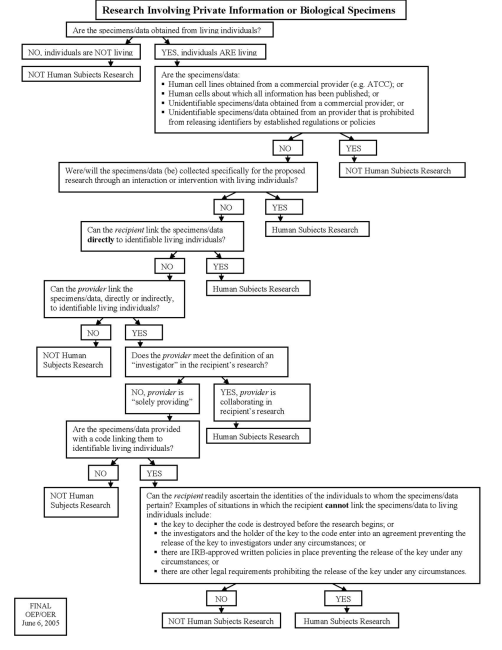
The National Institutes of Health (NIH) Research Involving Private Information or Biospecimens Flowchart serves as a guide to whether research with private information or specimens meets the criteria of human subject research requiring IRB Review.
YES: IRB review is required if the recipient researcher:
- can readily ascertain the identity of the donor directly or by associated information;
- requires fresh tissue from participants known to the recipient;
- uses de-identified tissue to test FDA-regulated diagnostic devices (FDA’s definition of human subject includes de-identified tissue) or
- requires identifiers to conduct the research (e.g., to track outcomes in the medical record);
IRB review and approval would also be required if biobank personnel:
- propose to conduct research with banked specimens; or
- wish to collaborate with the recipient researcher on the conduct, analysis, or reporting of the research.
As part of the review, the IRB would consider whether the original consent covered the secondary use or if added verbal or written consent would be needed.
Provide the IRB number for the bank providing specimens in the secondary research application.
Specimen Use Agreement
The biobank may require recipient researchers to sign or agree to a Use Agreement. The agreement may specify that the recipient researcher:
- will not attempt re-identification of specimens,
- will provide an NHR determination or obtain IRB review for the secondary research;
- conduct research consistent with the terms of the original biobank informed consent; and
- avoid group harms by presenting non-stigmatizing results.
The agreement should also specify that biobank personnel will serve as honest brokers and will not be involved in the conduct or reporting of the secondary research conducted by the recipient researcher.
NIH Decision Chart
References
- Ashley, Sonia, MAS, and Ira Goodman, CRA. “Establishing and Maintaining an Academic Biorepository.” JOURNAL OF RESEARCH ADMINISTRATION XLVI.2 (2015). Society of Research Administrators International. 2015. Web. 18 May 2017.
- “National Comprehensive Cancer Network.“ NCCN Points to Consider on the Best Practices for Biorepositories, Registries, and Databases. National Comprehensive Cancer Network, 2017. Web. 18 May 2017.
- ”NCI Best Practices for Biospecimen Resources.“ BBRB – Biorepositories and Biospecimen Research Branch. National Cancer Institute, Mar. 2016. Web. 18 May 2017.