For studies with risk level 2 and moderate or greater likelihood of impaired consent capacity (2 C i–iv), investigators describe and provide examples of safeguards or tools they intend to employ in conducting the research. Specific enhancements to the consent form and process may serve to improve a prospective participant’s understanding and enable individuals who otherwise have limitations in consent capacity to make competent decisions.
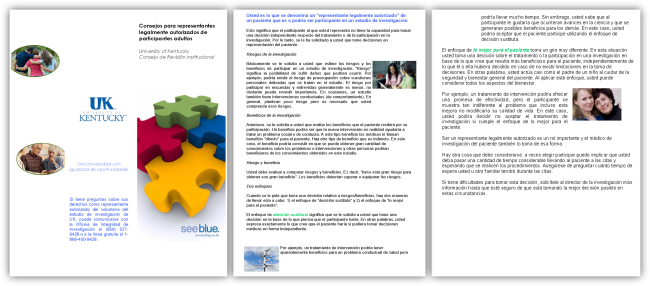
a. Use of guidance for a legally authorized representative to provide informed consent on behalf of the participant: When potential participants have been assessed as having impaired consent capacity, the investigator must engage a Legally Authorized Representative (LAR) to provide informed consent on the potential participant’s behalf. Investigators should present information on how this selection will be made and how the LAR will be educated about making the consent decision. The IRB has the following electronic documents that can be provided to LARs to help them understand their special role.
- Advice to Legally Authorized Representatives of Adult Participants in Medical Research
- Advice to Legally Authorized Representatives of Adult Participants in Nonmedical Research
b. Adult assent verbal or written: When potential participants have been assessed as having limited or impaired consent capacity, the investigator should obtain assent. Failure to object should not, absent affirmative agreement, be construed as assent. Where impairment is too great even for obtaining assent, investigators may need to carefully consider attention to subject dissent.
A sample assent form is available on the ORI website. Obtaining assent may not be applicable in some cases, such as where participants are physiologically incapable of responding to investigator questions. Verbal assent may be appropriate in cases where a subject is unable to sign an assent form.
c. Method for assessing dissent: The investigator must describe what methods are to be used to assess dissent among participants with limited or impaired consent capacity. Participants may exhibit behaviors or non-verbal cues (e.g., becoming upset, moving away, facial expressions, etc.) that indicate their desire not to participate. In addition, they may be asked to make a defined signal or gesture (e.g., shaking the head, using the “thumbs down” sign, etc.) to indicate their desire not to participate or stop participation.
d. Study overviews: Use of a study overview may enable an individual with limited consent capacity to make a decision regarding study participation. A study overview summary is written in simple language that distills the principal ideas from a consent form. Not to be used as a substitute for the full consent document, this tool provides an overview of the primary consent elements for initial consideration in the consent process. From that baseline, the process may continue with additional layers of detail.
e. If consent capacity is assessed as likely to fluctuate over time, describe intervals or conditions for re-consent. The recommended plan for participants with a higher likelihood of changes in consent capacity over the duration of the study should incorporate set timeframes for reassessing consent capacity. Study design implications, such as timing of risky procedures, sequence of intervention, and lengthy periods of no contact, should be considered when determining the appropriate timeframe for re-assessment and/or re-consent. The Investigator should explain why they do not plan to follow a specific timeframe and can describe an alternative plan.
f. Other considerations and potential safeguards. Investigators should use fair and impartial recruitment practices in research and avoid practices that place participants at risk for coercion or undue influence. The investigator should describe any other educational techniques or consent process alterations he/she plans to employ.
g. Institutionalized subjects. The impact of institutionalization may further compromise the voluntariness of an individual with impaired consent capacity. Investigators must not involve this population for convenience purposes. Investigators should justify the use of institutionalized subjects and take measures to ensure decisions are voluntarily made, free of influence or potential or perceived impact on involuntary confinement.