Skip to main
University-wide Navigation

Comparison of Imaging Instruments/Methods

Lightsheet Microscopy Overview

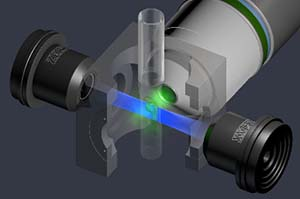
Light sheet fluorescence microscopy (LSFM) is an imaging method that uses one or more illumination objectives to excite fluorophores in a specimen with a thin sheet of light. Emitted light from the sample is then visualized by a separate imaging objective that is perpendicular to the illuminating lightsheet. 

an illustration of a light microscopy system scanning a sample
Image courtesy of Carl Zeiss AG

Light sheet microscopy (LSFM) has several advantages over confocal microscopy (LSCM):

  • Excellent sample penetration- In conventional confocal microscopy, excitation illumination must pass from the objective through the sample to the plane of focus, then emitted light must return through the sample and into the objective via the same light path.  The compounded scattering of both excitatory and emitted light limits sensitivity and resolution in thick samples.  In LSFM, the excitation light sheet comes from dedicated illumination objectives and emitted light from the sample is detected by a separate imaging objective.  This reduces light scattering and improves imaging in thick specimens.
  • High speed- In confocal microscopy, the excitation laser scans across the sample field and emitted light is captured by a photo-multiplier tube, constructing an image pixel by pixel.  In LSFM, The entire focal plane is illuminated at once, allowing an image to be collected using a high speed camera. 
  • Minimal phototoxicity and photobleaching- Because excitatory light is passing through the entire depth of the sample in confocal microscopy, there can be significant bleaching of the sample and a high risk for phototoxicity in live specimens.  Because only a thin sheet of excitatory light is used in LSFM and because imaging with a camera is rapid, this method dramatically reduces photobleaching and phototoxicity.

These properties make LSFM ideal for many biological imaging applications, including:

  • Fluorescence imaging of thick samples
  • Long term imaging of live samples

For more information about LSFM, visit MicroscopyU.

Fluorescence Microscopy Comparison Chart

Method Resolution Imaging Depth Speed Bleaching/Toxicity
Wide-field good low (microns) fast low
Confocal (LSCM)*  ** good moderate (10s of microns) slower moderate/high
Multi-photon** good good (100s of microns) slower moderate/high
Light sheet (LSFM)* good good (100s of microns) fast low
Super-resolution-SIM** very good low (microns)    
Super-resolution-STORM** excellent low (microns)    

Exact properties for each method are dependent on specific system configurations. General properties shown here are derived from published sources (Combs and Shroff, 2017).

*Instruments available in the CGI Core
**Instruments available in Light Microscopy Core.

Comparison of Light Sheet Microscopes

The CGI Core offers two microscopes capable of performing LSFM, the Zeiss Lightsheet Z.1 and the Leica SP8 DLS. They use very different implementations to create a light sheet (see individual microscope pages).

The table below highlights operational differences between the two microscopes.

  Zeiss Lightsheet Z.1 Leica SP8 DLS
Maximum sample width ~10mm ~4mm
Minimum imaging volume ~20ml ~5ml
Sample rotation ability Yes No
Multiview acquisition Yes No
Pivot scanning Yes No

For more information or to discuss the best options for your imaging application, please contact us.


User Publications

Lightsheet Microscopy

R.A. Petersen and A.C. Morris (2021). Visualizing Ocular Morphogenesis by Lightsheet Microscopy using rx3:GFP Transgenic ZebrafishJ. Vis. Exp. 170:e62296

S. Purushothaman, A. Elewa, A.W. Seifert (2019). Fgf-signaling is compartmentalized within the mesenchyme and controls proliferation during salamander limb development. eLife 2019;8:e48507.

Transcriptomics/Genomics

L.A. Johnson, K. Saito, A.V. Pallerla, J.L. Funnell, A.R. Ezzo, C.L. Song, D.A. Harrison, N.J. Norton, L.C. Moore, L.J. Van Eldik, D.W. Fardo, G.E. Cooper, J.M. Morganti (2026). Clonal expansion of cytotoxic CD8+ T cells in lecanemab-associated ARIA. Nature Comm., https://doi.org/10.1038/s41467-026-68921-3

X. Rao et al. (2025). mTORC1-Dependent Regulation of the CCL24-CCR3 Axis Controls Granuloma Formation and Maintenance in Sarcoidosis. BioRxiv

K.E. Foley et al. (2025). Acute Communication Between Microglia and Nonparenchymal Immune Cells in the Anti-Aβ Antibody-Injected Cortex. J. Neurosci. 45:e1456242024

S.K. Arya et al. (2025). Cellular and functional heterogeneity of fall armyworm (Spodoptera frugiperda) midgut: a single cell RNA sequencing analysis. J. Pest Science 98:987-1002

S.K. Arya, D.A. Harrison, and S.R. Palli (2024). Deciphering cellular heterogeneity in Spodoptera frugiperda midgut cell line through single cell RNA sequencingGenomics 116:110898

Y. Kong et al. (2023). Single-cell analysis characterizes PLK1 as a catalyst of an immunosuppressive tumor microenvironment in LUAD. BioRxiv

S. Lee et al. (2023). APOE4 drives transcriptional heterogeneity and maladaptive immunometabolic responses of astrocytes. BioRxiv

S. Lee et al. (2023). APOE modulates microglial immunometabolism in response to age, amyloid pathology, and inflammatory challenge. Cell Reports 42:112196.

A.L. Byrd et al. (2023). Dysregulated Polycomb Repressive Complex 2 contributes to chronic obstructive pulmonary disease by rewiring stem cell fate. Stem Cell Reports 18:289-304.

Z.R. Hettinger et al. (2022). Mechanotherapy reprograms aged muscle stromal cells to remodel the extracellular matrix during recovery from disuse. FUNCTION 3:zqac015.

Y. Wen, D.A. Englund, B.D. Peck, K.A. Murach, J.J. McCarthy, C.A. Peterson (2021). Myonuclear transcriptional dynamics in response to exercise following satellite cell depletion. iScience 24:102838.

K.L. Van Der Meulen, O. Vocking, M.L. Weaver, N.N. Meshram and J.K. Famulski (2020). Spatiotemporal characterization of anterior segment mesenchyme heterogeneity during zebrafish ocular anterior segment development. Front. Cell Dev. Biol. 2020.00379.

VAST BioImager

M.G. Haney, L.H. Moore, J.S. Blackburn (2020). Drug screening of primary patient derived tumor xenografts in zebrafish. J. Vis. Exp. 158:e60996.

Confocal Microscopy

L.A. Krueger, J.D. Bills, Z.Y. Lim, J.M. Skidmore, D.M. Martin, A.C. Morris (2023). Chromatin remodeler Chd7 regulates photoreceptor development and outer segment length. Exp. Eye Res. 226:109299.

K.F. Titialii-Torres and A.C. Morris (2022). Embryonic hyperglycemia perturbs the development of specific retinal cell types, including photoreceptors J. Cell Sci. 135(1): jcs259187.

C.E. Coomer et al. (2020). Her9/Hes4 is required for retinal photoreceptor development, maintenance, and survival. Sci Rep 10:11316.


Publications/Acknowledgement Information

In addition to user fees, support for the Cellular Genomics and Imaging Core is provided by the Office of the Vice President for Research and grants provided for specific instruments. Continued support and grant success depends on demonstration of the value of the facility and instrumentation to the research community. We ask that you please acknowledge the core in publications, including images or data collected in the facility.

In addition to general acknowledgement of the CGI Core, for publications involving use of the Zeiss Lightsheet Z.1, please include the following statement: 

“Research reported in this publication was supported by the Office Of The Director of the National Institutes of Health under Award Number S10OD020067. The content is solely the responsibility of the authors and does not necessarily represent the official views of the National Institutes of Health.”
 

For publications involving use of the Union Biometrica VAST Imaging System or BioSorter Pro, please include the statement:

“Research reported in this publication was supported by the Office Of The Director of the National Institutes of Health under Award Number S10OD025033. The content is solely the responsibility of the authors and does not necessarily represent the official views of the National Institutes of Health.”

We would also appreciate it if you would please send us your publications to be included here and reported to granting agencies.


FAQs

How do I sign up to use an instrument?

You can submit an online Equipment Reservation Form to request a particular date and time. Equipment availability can be viewed on the Google Calendar for each instrument found on the Scheduling page.

How do I get trained to use an instrument?

Submit an online Equipment Reservation Form and indicate in the "Notes" field that you would like to receive training at that time.

I have used a similar instrument in the past. Do I still need to go through training?

Yes. We want to know that all users have received proper instruction in using the instrumentation and are aware of procedures in the A&S Imaging Center. Although users are charged for training, the expense is credited against their first independent session on the instrument, so training does not incur any additional cost. 

How do I pay for equipment use?

UK users provide a valid account number at the time of service. Charges are entered into the university system monthly and the PI will receive a report of charges by email. External users may pay by credit card and will be provided with a link to enter payment information.


Web Links

General microscopy education

  • Microscopy U- A collection of educational articles, tutorials, and tools on optics and microscopy

Light Sheet Fluorescence Microscopy (LSFM)

Confocal Microscopy (LSCM)

Arivis Vision4D