Record crowd, standout talks mark GradResearch Live! 2025
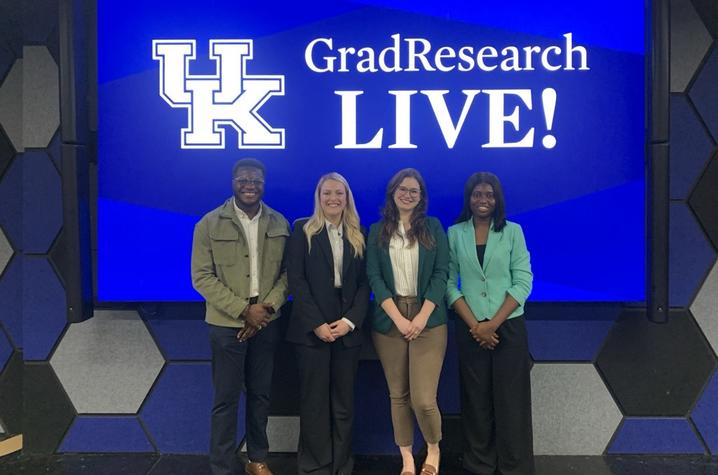
The University of Kentucky Graduate School welcomed a record-setting audience to GradResearch Live! this fall, marking the largest participation and attendance in the event’s history.
Held Nov. 5 in the Esports Theater at The Cornerstone, the annual event featured short research presentations from graduate students representing programs across the university. The theater reached full capacity as attendees listened to students explain their research clearly and concisely for a general audience.
GradResearch Live! is UK’s campus showcase for the global Three Minute Thesis (3MT) competition. 3MT is an annual competition at universities worldwide. Participants are challenged to present their research in three minutes using a single static slide. The format emphasizes clarity, focus and communication without technical jargon. Panelists evaluate the presentation and award prizes for first ($750 and advancement to regionals), second ($500) and third ($250) places. The people’s choice award ($250) is decided by an audience vote.
The time constraint requires students to distill complex research into its most essential elements. As a result, presentations highlight the research question, approach and potential impact in an accessible way. Audience members leave with a practical understanding of research topics and their real-world relevance.
“It was inspiring to attend GradResearch Live! to learn more about the incredible research our students are conducting alongside their peers, faculty and mentors,” said Brandi N. Frisby, Ph.D., acting director of The Graduate School. “Their work was innovative, creative and entrepreneurial, and it has the potential to make an impact on their disciplines and on the lives of many people. It was an engaging night, and I look forward to seeing where these students go with their research in the next phase of their education and careers.”
This year’s event included the largest group of presenters and the biggest audience to date. Attendees included family members, peers, faculty mentors and community guests from across campus.
A cross-campus panel with expertise in student support, research development, innovation and libraries evaluated the presentations. Panelists were John Blaine, director of UK’s Center for Graduate and Professional Services; Will Boose, UK proposal development officer; Kendra Hargis-Stenzel, director of innovation talent development with Launch Blue; and Isaac Wink, research data librarian with UK Libraries.
Winners
Three Minute Thesis
Master’s and doctoral students in their late stage of research with results and conclusions, competed in the standard three minute thesis track.
- First Place: Alyson Ackerman Olivelli; Department of Chemistry, College of Arts and Sciences
- Ackerman studies triple-negative breast cancer by testing plant-derived compounds to identify new ways to target tumor cells while minimizing harm to healthy tissue. Her work combines natural product discovery with chemical design to improve treatment effectiveness and reduce side effects.
- Ackerman studies triple-negative breast cancer by testing plant-derived compounds to identify new ways to target tumor cells while minimizing harm to healthy tissue. Her work combines natural product discovery with chemical design to improve treatment effectiveness and reduce side effects.
- Second Place: Courtney Martin; Department of Kinesiology and Health Promotion, College of Education
- Martin’s presentation focused on how Alzheimer’s disease affects caregivers in Appalachia, especially the strain experienced by family caregivers providing care at home. Her research explored the mental health impact on caregivers and emphasized the need for stronger support plans from hospitals to better support families caring for loved ones with Alzheimer’s. When caregivers are not given the support they need, patient outcomes can suffer as well.
- Martin’s presentation focused on how Alzheimer’s disease affects caregivers in Appalachia, especially the strain experienced by family caregivers providing care at home. Her research explored the mental health impact on caregivers and emphasized the need for stronger support plans from hospitals to better support families caring for loved ones with Alzheimer’s. When caregivers are not given the support they need, patient outcomes can suffer as well.
- Third Place: Odianosen Ewah; Department of Chemical and Materials Engineering, Stanley and Karen Pigman College of Engineering
- Ewah is redesigning part of the papermaking process to reduce pollution without sacrificing jobs. His research uses a plant-based solvent and membrane technology to improve air and water quality in a long-established industry.
- Ewah is redesigning part of the papermaking process to reduce pollution without sacrificing jobs. His research uses a plant-based solvent and membrane technology to improve air and water quality in a long-established industry.
- People’s Choice: Damilola Petinrin; Department of Chemistry, College of Arts and Sciences
- Petinrin studies how pollutants transform on everyday surfaces and how those reactions affect air quality. Her work supports improved decision-making related to environmental health in Kentucky and beyond.
Pre-Three Minute Thesis
Master’s and doctoral students early in their research or proposal stage with preliminary findings competed in the pre-three minute thesis track.
- First Place and People’s Choice: Tiffany Odita; Department of Chemistry, College of Arts and Sciences
- Second Place: Hammas Khalid; Department of Mining Engineering, Stanley and Karen Pigman College of Engineering
- Third Place: Maddie Kushner; Department of Psychology, College of Arts and Sciences
First place winner Alyson Ackerman Olivelli recently advanced to the Conference of Southern Graduate Schools’ regional 3MT competition in Baton Rouge, Louisiana, this February. Representing both UK and Kentucky, Ackerman made it to the finals and won the People’s Choice award.
“I most loved meeting with other people who are passionate about science communication. Not only were their 3-minute speeches impeccable, we shared easy and engaging scientific conversation over meals, drinks. and even line dances,” Olivelli said. “The ability to pare down scientific jargon is necessary to bridging gaps between fields, understandings between the public and professionals and furthering discoveries across all disciplines.”