Doug Boyd: 2026-27 University Research Professor Q&A
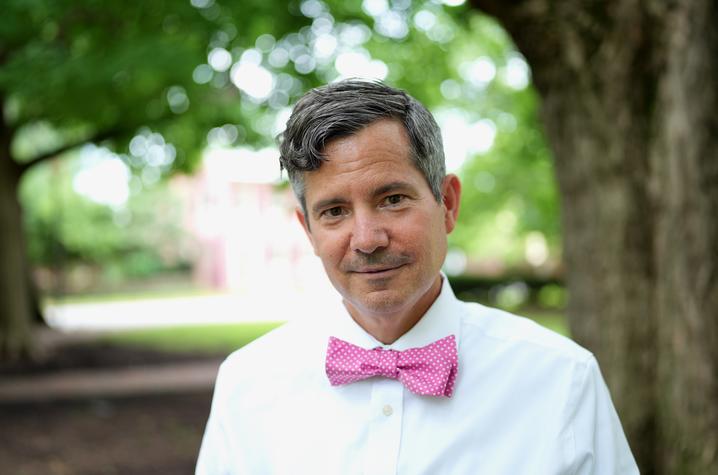
Douglas A. Boyd, Ph.D., director of the University of Kentucky Libraries Louie B. Nunn Center for Oral History and recent president of the Oral History Association, has been honored as a 2026-27 University Research Professor.
Boyd envisioned, designed and implemented the open-source Oral History Metadata Synchronizer (OHMS) system, which combines text with audio and video online. In 2019, Boyd received a Fulbright Scholars Research Grant to collaborate with the National Library of Australia on innovative access to online oral history.
He is the author of “Oral History: A Very Short Introduction” and “Crawfish Bottom: Recovering a Lost Kentucky Community.” Boyd is also the co-editor, with Mary A. Larson, of “Oral History and Digital Humanities: Voice, Access, and Engagement.” He has published numerous articles on oral history, archives and digital technologies.
More recently, Boyd designed SpeakEZ, an AI-driven system that transcribes, describes and assesses archived oral history interviews. SpeakEZ integrates transcription, metadata generation, named-entity recognition, indexing and sensitivity review into a cohesive, ethically grounded workflow. This initiative not only accelerates archival processing but also models responsible AI integration within the humanities.
Before coming to UK in 2008, he managed the Digital Program for the University of Alabama Libraries, served as the director of the Kentucky Oral History Commission and worked as the senior archivist for the oral history collection at the Kentucky Historical Society. Boyd received his Ph.D. and M.A. in folklore from Indiana University.
He spoke with UKNow about his latest honor as a University Research Professor in this Q&A.
UKNow: What does it mean to you to be recognized as a University Research Professor?
Boyd: Receiving this recognition is both humbling and deeply meaningful. While it acknowledges my own research, it also reflects the collaborative work of an exceptional team at the Louie B. Nunn Center for Oral History, the University of Kentucky Libraries and our many partners across campus and around the world. UK Libraries has created an environment where creativity, experimentation, research and innovation reinforce one another, allowing us to explore new approaches to recording, preserving and enhancing access to oral history. It is especially gratifying to know that work rooted in libraries and archives is being recognized alongside the outstanding research taking place across the university.
UKNow: How will the professorships program advance your research?
Boyd: This professorship provides momentum at an exciting time in my research. Oral history is entering a period of rapid transformation as artificial intelligence creates new possibilities and new responsibilities for libraries and archives. My current work focuses on developing ethical and practical ways to use AI to improve access to oral history collections while maintaining the human centrality that gives these interviews and collections their profound meaning. This recognition will strengthen opportunities for interdisciplinary collaboration, allow me to expand campus, local, national and international partnerships and help position the University of Kentucky as a leader in shaping the future of ethical AI deployment in libraries and in the humanities. In parallel with my work on AI and ethical access, this opportunity will enable me to personally conduct additional oral history projects, rebalancing my research time between technology and people.
UKNow: What inspired your focus on this area of research?
Boyd: I've always been fascinated by the power of individual stories to deepen our understanding of history and culture. Oral history preserves perspectives that often don’t appear in traditional historical records, but I also realized early in my career that these archival collections were difficult to discover and use. That challenge continues to inspire much of my research as I became interested in developing technologies that make oral histories more navigable, discoverable and accessible without losing the context, complexity and humanity that make them so valuable.
UKNow: What continues to motivate your work?
Boyd: What continues to motivate me is the opportunity to preserve and then to connect people with stories that matter. Every oral history interview captures a unique human experience. I find it incredibly rewarding to develop infrastructure and tools that help these stories reach students, researchers and the public more effectively, and to enable individuals and communities to connect with and find meaning in them. I’m also motivated by the pace of technological change. When it comes to AI and humanity, there are still more questions than answers. I am interested in how these technologies can be used responsibly and ethically, in ways that strengthen rather than diminish the work of archivists, librarians, students, historians and communities. I believe there is still tremendous potential to create frameworks of ethical access, while remaining careful and thoughtful stewards of individual life stories and the resulting historical record.
UKNow: How does your research impact Kentucky?
Boyd: Kentucky plays a tremendous role in the international oral history community. The Nunn Center collection has over 20,000 interviews documenting the Commonwealth’s people, communities, industries and culture, ensuring that these voices remain available for future generations. At the same time, the technologies we’ve developed at the University of Kentucky, including OHMS and, more recently, the SpeakEZ, have had (and will have) a tremendous impact far beyond our state, empowering institutions around the world to improve access to their own collections. Enhancing our ability to fully process archived interviews on the archive side will enable us to conduct more interviews and document Kentucky’s stories more comprehensively. I take great pride in the fact that innovations developed in Kentucky are influencing international standards for oral history, libraries and archives.
About the University Research Professors
Each year, the University of Kentucky Board of Trustees approves a cohort of faculty as University Research Professors. The distinction recognizes excellence in work that addresses scientific, social, cultural and economic challenges in Kentucky and the world.
College leadership developed criteria for excellence within their area of expertise and then nominated faculty who excelled at these criteria. Each University Research Professor receives a one-year award of $10,000.