Miriam Kienle: 2026-27 University Research Professor Q&A
UKNow is highlighting the University of Kentucky’s 2026-27 University Research Professors. Established by the Board of Trustees in 1976, the professorship program recognizes excellence across the full spectrum of research at UK and is sponsored by the Office of the Vice President for Research.
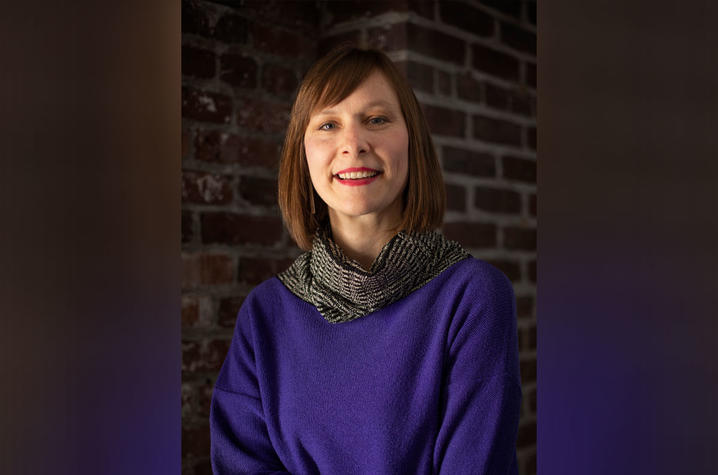
Miriam Kienle, Ph.D., associate professor of art history in the School of Art and Visual Studies in the College of Fine Arts at the University of Kentucky, has been honored as a 2026-27 University Research Professor.
Her teaching and research interests include new media studies, curatorial studies, gender and sexuality in art, and the digital humanities. Kienle’s research practice also includes curating exhibitions on a range of topics from the international mail art movement to contemporary queer and feminist art.
Kienle is the author of “Queer Networks: Ray Johnson’s Correspondence Art,” published in 2023, and was the editor of the Artl@s Bulletin 2017 special issue “Visualizing Networks: Approaches to Network Analysis in Art History.” Her work has also appeared in journals including the Oxford Art Journal, Archives of American Art Journal, Feminist Studies, Media-N and Panorama.
Kienle’s research has been supported by Terra Foundation for American Art, College Art Association, American Council of Learned Societies, Henry Luce Foundation, J. Paul Getty Foundation and the Association of Historians of American Art.
She joined UK in 2015 and spoke with UKNow about her latest honor as a University Research Professor in this Q&A.
UKNow: What does it mean to you to be recognized as a University Research Professor?
Kienle: I am honored and humbled to be recognized alongside the other incredible University Research Professors. I have always been impressed by the important and varied work that this award supports. For me, being a University Research Professor means fostering ingenuity and excellence in our respective fields of research.
UKNow: How will the professorships program advance your research?
Kienle: This award comes at an important transition moment in my career as I take on larger projects, including an edited volume of essays on the international mail art movement. It offers time and resources — things in short supply as a working parent — to conduct research in archives and meet with other scholars at conferences to share ideas about the impact of this under-researched art movement. Mail art (also known as “correspondence art” or “postal art”) is an artistic practice that emerged in the 1950s, in which artists used the postal system as an alternative way to produce, distribute and exchange art. By using the modern postal system rather than traditional institutions like public museums and commercial galleries, mail artists from around the world embraced a more accessible, collaborative and intimate form of artistic exchange that challenged the inequities of the global art market and restrictions on cultural exchange, bypassing not only commercial institutions but also government censorship during the Cold War. With my book, I hope to tell that story.
UKNow: What inspired your focus on this area of research?
Kienle: The artists that I study inspire my scholarship. I see their efforts offering alternative models for being and belonging in our divisive times. For instance, the international network of mail artists provides a historical example of artists demonstrating how one-to-one global exchanges, rooted in generosity and reciprocity, can traverse deep geopolitical divides. Within this body of research, I am also interested in how recent scholarship sheds light on the overlooked contributions of women and LGBTQ+ mail artists as well as those from rural areas or cities outside dominant artistic centers like New York, Paris and London. This research casts a wider lens on the collaborative artistic models of postal art that propose alternative modes cultural production.
UKNow: What continues to motivate your work?
Kienle: I am motivated by the difficult dialogues that art can facilitate and the new visions of the world it can inspire. I’m especially compelled by the way art can create space for perspectives that might otherwise go unheard, inviting people to question assumptions and engage more deeply with one another. I see the potential to spark both personal reflection and meaningful social change.
UKNow: How does your research impact Kentucky?
Kienle: Rather than focus solely on the national and international stage, I often curate exhibits and organize public talks at UK and other local and regional venues. With these projects, I strive to build connections locally and nationally in ways that foster creativity, togetherness and greater accountability in the arts. I do this by focusing on under-considered artistic practices, such as mail art, and investigating how artist networks operate across distance and difference. I am also deeply committed to preserving the histories of artists whose work has historically been vulnerable to neglect, destruction and loss, including those in Kentucky. I often collaborate with local artists and archives to make exhibitions, including UK Special Collections and the Faulkner Morgan Archive.
About the University Research Professors
Each year, the University of Kentucky Board of Trustees approves a cohort of faculty as University Research Professors. The distinction recognizes excellence in work that addresses scientific, social, cultural and economic challenges in Kentucky and the world.
College leadership developed criteria for excellence within their area of expertise and then nominated faculty who excelled at these criteria. Each University Research Professor receives a one-year award of $10,000.