Sanders-Brown graduate transforms personal loss into research impact
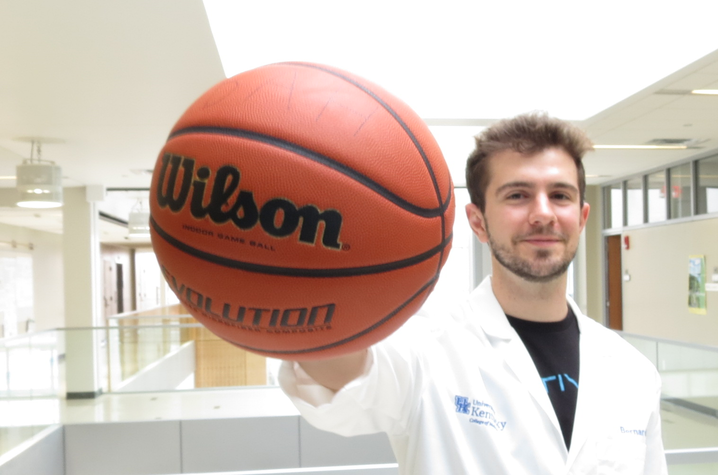
The University of Kentucky’s Sanders-Brown Center on Aging is home to researchers pushing the field of Alzheimer’s science forward — among them, soon-to-be graduate Bernardo Aguzzoli Herbele, who will earn his doctorate in neuroscience this month. Working in the lab of Mark Ebbert, Ph.D., Bernardo focuses on understanding RNA isoforms in the brain, using large-scale long-read RNA sequencing to uncover molecular differences that may influence Alzheimer’s risk or resilience.
As he prepares for his next chapter, Aguzzoli Herbele reflects on his journey, his research and the relationships that defined his time at UK.
Q: What inspired you to pursue research in Alzheimer’s disease?
A: My interest in Alzheimer’s disease is very personal. I lost both of my grandfathers to the disease at a young age, and witnessing its impact on my family motivated me to dedicate my Ph.D. to trying to make an impact in Alzheimer’s research.
Q: What brought you to the University of Kentucky?
A: I am originally from Porto Alegre, Brazil. I had a passion for basketball — instead of soccer — while growing up. This passion led me to participate in a high-school exchange program in the United States, where I had the opportunity to not only pursue my love for basketball, but also immerse myself in a new culture and educational system. After my high school exchange program ended I went back to Brazil and decided to apply for college in the United States. I was fortunate to receive academic scholarships to the University of Kentucky where I started as a computer science major and ended up graduating with a neuroscience degree, laying the foundation for my future research endeavors. After graduating in 2019, I returned to Brazil for two years, and because of how positive my undergraduate experience had been, I decided to come back to Kentucky to pursue graduate research in Alzheimer’s disease.
Q: What is the focus of your research?
A: My work centers on understanding RNA isoforms in the context of Alzheimer’s disease. Using long-read RNA sequencing and computational analysis, I examined 115 post-mortem brain samples. The goal is to learn how different RNA isoforms behave in Alzheimer’s disease versus cognitively intact individuals — and how they might contribute to risk or resilience.
Q: Why is RNA isoform research important for Alzheimer’s disease?
A: Traditional sequencing methods often miss the complexity of RNA isoforms. With long-read sequencing, we can see full-length transcripts and uncover variations that may affect how genes function in the brain. By identifying isoforms that differ significantly in Alzheimer’s disease, we hope to find new biomarkers or therapeutic targets.
Q: What excites you most about your work?
A: I’m excited by the scale and depth of the data we’re working with. With 115 high-throughput samples, this is — at least to my knowledge — the largest long-read RNA-seq dataset available. Having the opportunity to work with data that can genuinely push the field forward is incredibly motivating.
Q: What are your future goals and plans after graduation?
A: After graduation, I will be joining Genentech, a major biotechnology and pharmaceutical company, where I’ll be developing data analysis pipelines and tools to help drive the next wave of therapies across a wide range of diseases. My long-term career goals are twofold: first, to continue combining my computational and life-science expertise to help fight disease and improve human health; and second, to contribute to strengthening the scientific landscape in my home country, Brazil, by mentoring young scientists and fostering international collaborations.
Q: What has been your favorite part about your time at the University of Kentucky?
A: My favorite part of my time at the University of Kentucky has been the people I’ve met. I’ve found great friends, mentors, colleagues — and even met my wife here. The welcoming and collaborative atmosphere on campus makes it easy to form meaningful and lasting connections.