UK researcher helps solve longstanding black hole mystery
A decades-old mystery about supermassive black holes may finally have an answer.
University of Kentucky astronomer Gary Ferland, Ph.D., is part of an international team that has uncovered new evidence explaining how supermassive black holes continue to grow despite releasing enormous amounts of energy.
Using observations from NASA’s James Webb Space Telescope (JWST), Ferland and his team, led by the Université de Montréal, have captured one of the clearest views yet of a self-sustaining cycle in which gas cools, flows inward and feeds a supermassive black hole. The findings, published today in the Astrophysical Journal Letters, provide new insight into how black holes and galaxies evolve together over cosmic time.
Ferland, who is a professor of astronomy in the UK College of Arts and Sciences, contributed to the study by applying Cloudy, a sophisticated computer modeling code he developed at UK. The software has been used by astronomers around the world for more than 45 years to interpret light from astronomical objects.
“The James Webb Space Telescope observes light from gas and dust under conditions that could never be studied before,” Ferland said. “Astronomers learn the most from spectra — the rainbows produced when light is spread into its component colors. JWST includes superb spectrometers that reveal the physical conditions, motions and chemical composition of gas in unprecedented detail.”
Ferland’s role in the project was to interpret the JWST spectra using Cloudy.
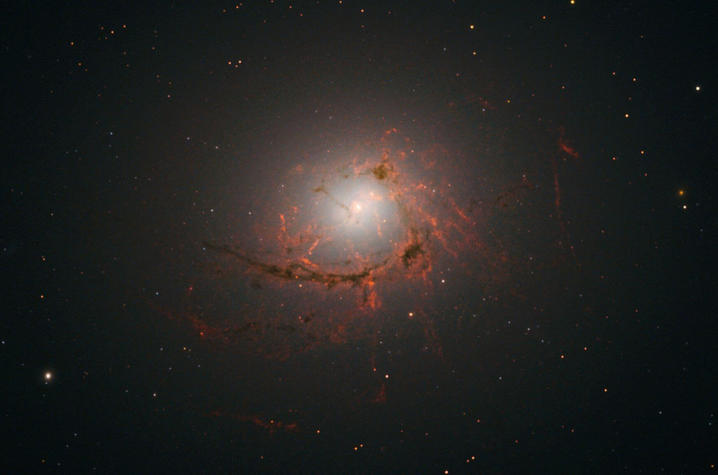
The research focused on NGC 4696, a giant galaxy at the center of the Centaurus Cluster of galaxies located approximately 145 million light-years from Earth. Previous observations hinted at unusual gas structures near the galaxy’s central black hole, but the James Webb Space Telescope provided the detail needed to map how that gas moves.
Researchers found that a swirling structure near the galaxy’s center forms a rotating disk of gas surrounding the black hole and is connected to larger streams of infalling gas extending throughout the galaxy. The observations showed gas flowing along these filaments into the disk and ultimately toward the black hole itself.
For decades, astronomers have puzzled over how active supermassive black holes continue to grow. These black holes release tremendous amounts of energy into their surroundings through powerful jets that heat nearby gas. In theory, that process should cut off the black hole’s fuel supply.
Instead, the new observations suggest the heated gas can cool, condense into long filaments and flow back inward, creating a self-regulating cycle that continually replenishes the black hole.
“Our observations reveal how cool streams of gas can feed the black hole despite the energy it releases, helping explain how galaxies and their central black holes evolve together,” Ferland said.
The findings provide some of the strongest observational evidence yet for a process astronomers have long theorized but struggled to observe directly.
“JWST allowed us to watch gas flowing into the rotating disk around the black hole for the first time,” Ferland said. “Gas reaches the black hole through this rotating disk, while other material is driven outward in jets aligned with the black hole’s north and south poles. We are much closer to understanding how supermassive black holes regulate the evolution of galaxies.”
The study also highlights the continuing role of UK’s Cloudy code in helping scientists interpret data from new generations of space observatories.
“The Cloudy team here at the University of Kentucky has been well supported by the JWST project,” Ferland said. “Cloudy was developed at UK to answer exactly the kinds of questions that JWST is now allowing astronomers to investigate. It’s tremendously exciting to see it helping interpret observations that simply weren’t possible before Webb.”
Ferland is now involved in follow-up research that will use Cloudy to analyze the detailed spectrum collected by the James Webb Space Telescope and investigate the physical conditions of gas surrounding the black hole.
“Two additional papers are underway,” Ferland said. “One will use Cloudy to analyze the rich spectrum measured by JWST. The emission lines in the spectrum are fingerprints of elements such as carbon, oxygen and nitrogen. By analyzing them with Cloudy, we can determine the temperature, density, chemical composition and other physical conditions of the gas surrounding the black hole.”
The paper, “JWST reveals how black holes are fed: kiloparsec-scale multiphase filaments feed sub-kiloparsec circumnuclear disks,” was led by Julie Hlavacek-Larrondo of the Université de Montréal and published in the Astrophysical Journal Letters.
Read more from Université de Montréal.
Support for U.S. investigators in program #5354 and #7033 was provided by NASA through a grant from the Space Telescope Science Institute, which is operated by the Association of Universities for Research in Astronomy Inc., under NASA contract NAS 5-03127.