UK researcher receives national ORAU Powe Award
There’s a structure called the cytoskeleton that holds together every cell in your body. Every time a cell divides or a neuron reaches out to form a memory, that internal structure must reorganize with perfect timing and spatial accuracy.
When cytoskeleton organization fails, a wide spectrum of human pathologies can occur, from cancer to neurodegeneration.
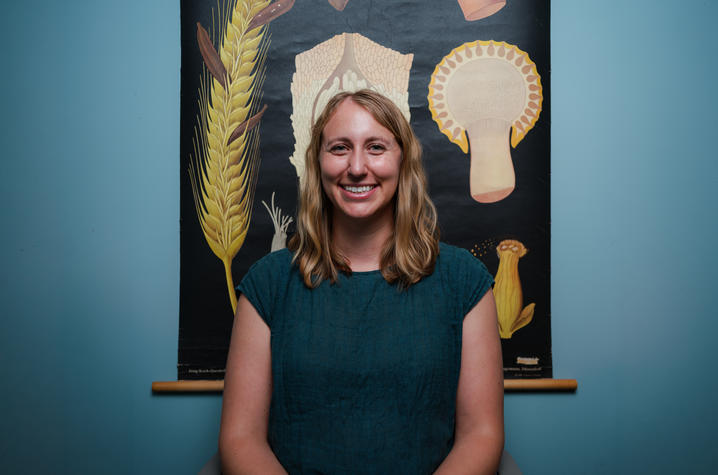
Alexandra Long, Ph.D., an assistant professor of biology in the University of Kentucky College of Arts and Sciences, has dedicated her career to understanding the cytoskeleton. Her approach, which merges evolutionary biology with high-resolution cell biology and biophysics, has earned her one of the most prestigious honors for early-career scientists: an Oak Ridge Associated Universities (ORAU) Ralph E. Powe Junior Faculty Enhancement Award.
The award, announced through the organization’s University Partnerships Office, provides seed money to enhance the research programs of junior faculty at ORAU member institutions.
Inside information
Long’s fascination with this cytoskeleton stems from its dynamic nature, which, unlike human bones, can turn over in seconds. For her, the cell is a mechanical puzzle.
“I really try to look at a cell the way an engineer does and think about how cells build such dynamic but mechanically strong structures,” Long said.
Her lab is particularly interested in cilia: hair-like projections that are part of the cytoskeleton and act as antennas or motors. When these structures fail, it leads to diseases called ciliopathies, which result from signaling problems (e.g. polycystic kidney disease) or mechanical issues when cilia do not propel fluid (e.g. cystic fibrosis in the lungs).
Tiny skyscrapers
Long said that although scientists have a “nearly complete parts list” of what makes a cilium, they still don’t fully understand how cells rearrange these parts. She compared building a cilium to a construction job.
“These are complex, elaborate, long structures that have important mechanical jobs,” Long said. “The way you build a skyscraper. It’s not random. You have a plan, and you execute that plan well at every floor to build a good skyscraper. It’s not just a pile of steel, concrete and windows.”
Unlike most engineers, however, cells must also know how to take the skyscraper down and reuse parts. If a cell needs to divide, it must disassemble its cilia to use the components for the division process.
“One of the things that cells do when they want to control what signals they’re receiving or not is disassemble their cilia,” Long said. “It can be a problem to have that antenna up at the wrong time.”
To understand diseases where cilia malfunction, Long believes scientists must first understand how cilia are built and remodeled.
“If you’re hiring someone to remodel your house, you want to hire someone who knows how a house is built,” she said. “Where are the load-bearing walls?”
Fungal framework
To study this disassembly, Long uses a model called chytrid fungi. Although most fungi lost their cilia millions of years ago, chytrids kept them because they are aquatic and use them to swim.
These fungi provide a unique research advantage: they have a 24-hour life cycle where they synchronously disassemble their cilia in about a minute.
“It’s like the leaves falling off a ginkgo tree,” Long said. “Everything is dropping all at once. And it becomes easier to look for patterns, to look for signal and to not be distracted by noise.”
By studying a rapid, synchronized version of a process that occurs in other cells, the lab can address fundamental questions about how these mechanisms arose in evolution and how they fail in human cells.
To see the intricate web of microtubules within these fungi, the Long lab uses a philosophy inspired by Yogi Berra: “You can observe a lot just by watching.”
Watching, in this context, requires more than just the naked eye.
One of the lab’s primary tools is expansion microscopy, a technique that makes small things easier to see by physically making them larger. Long explains the process using a surprisingly common household item: diapers. The technique uses sodium acrylate, the same chemical found in diapers that swells when water is added.
“We take our sample and embed it in a gel that swells when you add water to it,” Long said. “You make your sample larger rather than needing a much fancier microscope to see it.”
This advantage allows the lab to see the skyscraper structure of the cilia using a conventional fluorescence microscope.
The process is similar to the children’s toys where a tiny, dried sponge in the form of a dinosaur grows 10 times its size in water.
Kentucky menagerie
Long’s appointment at UK follows a distinguished academic path, including a Ph.D. from University of California, San Francisco as a National Science Foundation Graduate Research Fellow and a National Institute of Health postdoctoral fellowship at Stanford University. She was drawn to UK’s Department of Biology because of its support for nontraditional research models.
“The biology department at UK has an amazing menagerie of unusual and nontraditional model systems,” Long said, citing colleagues who work on axolotls, spiny mice and lamprey. “There’s a wealth of understanding in this department about how to leverage unique biology to make foundational discoveries that can impact human health.”
As the recipient of the Powe Award, Long will also collaborate with the UK Electron Microscopy and Materials Characterization Core, housed in the Advanced Science & Technology Commercialization Center (ASTeCC), to confirm her lab’s findings and capture early snapshots of the cellular disassembly process that happens in seconds.
For more information on her lab’s work, visit alonglab.org.
This work was supported in part by the Ralph E. Powe Junior Faculty Enhancement Award provided by Oak Ridge Associated Universities (ORAU).