UK HealthCare patient among first in US to receive experimental lupus treatment
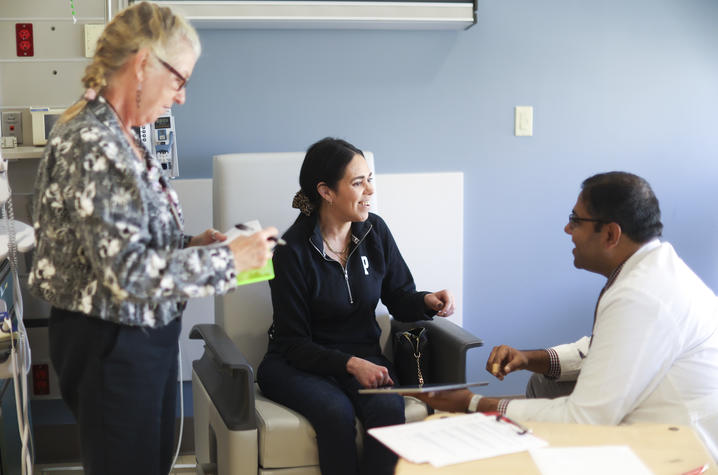
Angela Rondón-Colón, 43, was an active mother of three young boys when she received a life-altering lupus diagnosis at 25-years-old. Now, she has a second chance at a fresh start.
Rondón-Colón was diagnosed with systemic lupus erythematosus (SLE), the most severe and common type of lupus, which affects multiple organ systems in the body.
At least 1.5 million Americans and five million people worldwide have a form of lupus, according to the Lupus Foundation of America.
She is now the second patient in the U.S. to receive an experimental treatment for SLE.
As the spouse of an active-duty service member of the U.S. Army, Rondón-Colón was often the primary caregiver for her three young children while moving between Kentucky, Florida, Washington state and Puerto Rico.
In the early years after her diagnosis, her children were just 4, 2 and 1, and she had to balance chronic pain, medical appointments and household responsibilities while still in her 20s.
In Puerto Rico, Rondón-Colón relied on family members for childcare when she traveled to appointments. But frequent relocations often meant rebuilding that support system from the ground up.
"Starting over is difficult, but God always sends you little angels to help you,” Rondón-Colón said.
Throughout her battle with her autoimmune disease, her body began attacking her own organs, causing damage to her kidneys, lungs, heart lining, spinal cord and stomach.
Lupus symptoms commonly occur in flares where symptoms worsen, followed by period of remission. Rondón-Colón’s symptoms included chronic pain and joint pain, nausea and vomiting, fatigue and fever-like symptoms, and painful sores during flares.
“I wake up every morning … I still go to work … and people think that I’m fine. But that is actually a mask that I have on [because] I’m not feeling fine,” Rondón-Colón said.
After trying treatment after treatment with no success — and ultimately visiting the emergency department after her recent attempt at relief — Rondón-Colón said she was out of options.
“My last treatment was one I was already allergic to, and I was so desperate I even begged Dr. Antic to continue it just to get a little relief,” Rondón-Colón said.
Seeking new treatment options, Rondón-Colón’s primary rheumatologist at UK, Izabela Antic, D.O., determined that she met the qualifications for an experimental clinical trial spearheaded by UK HealthCare’s Division Chief of Rheumatology Paramarajan Piranavan, M.D.
Antic, who is also a sub-investigator on the trial, said she originally met Rondón-Colón during a clinic visit with a rheumatology fellow, and from that initial appointment, she recognized how sick she was.
“I saw new hope in the CAR T trial for lupus for a patient who had failed so many other therapies,” Antic said.
Rondón-Colón quickly became a candidate for the trial based on the severity of her disease. By age 43 she had multiple damaged organs, and because her body has rejected several treatments, she had limited options remaining.
The phase 2 clinical trial, funded by pharmaceutical company Novartis, uses CAR T-cell therapy — chimeric antigen receptor T-cell therapy — a treatment historically used for blood, bone marrow and lymphatic cancers.
As a pioneer in CAR-T cell therapy for hematologic malignancies, Piranavan credits the instrumental collaboration with the UK Markey Cancer Center’s Hematology/Oncology and Cell Therapy Program in establishing and successfully conducting the trial.
Chaitanya Iragavarapu, M.D., is the associate medical director of the Markey Cancer Center CAR T-Cell Therapy Program and served as the hematology subinvestigator on the trial where he worked closely with the rheumatology team.
Iragavarapu and his clinic team have been actively involved in the care of patients receiving CAR T-cell therapy since his arrival at UK in 2019.
“CAR T-cell therapy represents a treatment that once it’s applied, the effects can be long-term. And I think that can be meaningfully life-changing for our patients,” Iragavarapu said.
Also central to this complex clinical trial is the UK Center for Clinical and Translational Science, which has provided extensive support from its research coordinators, clinical research clinics and nurses, and regulatory and finance teams. Since the study involves multiple areas across UK’s research enterprise and hospital system, combining standard patient care with investigational treatment, there are unique challenges that require a multidisciplinary, creative and highly dedicated team.
“It has truly involved a herculean effort, and we are all so committed to the success of this clinical trial — not just for this patient but also to bring CAR T forward as a cutting-edge treatment beyond oncology and thus open up the doors for so many other therapeutic areas,” said Dorothy Ross, research coordinator and senior research development director for the CCTS.
“It takes a village, and there are so many interactions that sort of fly under the radar,” Iragavarapu said. “We get a lot of the credit, but truthfully, the credit should go to everybody else who’s on the team.”
CAR T-cell therapy collects a patient’s own T cells, a type of immune cell, and genetically engineers them to recognize and eliminate specific target cells, said Piranavan.
In SLE, an autoimmune disease, B cells produce autoantibodies that attack the body’s own tissues and organs.
“What we’ve learned is that by engineering a patient’s T cells to eliminate the B cells driving the disease, we can remove the source of those harmful autoantibodies and potentially reset the immune system,” Piranavan said.
After the lengthy screening process to confirm her candidacy, Rondón-Colón began the trial with chemotherapy to prepare her body for the cell therapy, which she said was a very difficult part of the process for her. Her immune cells were then collected and engineered to target cells responsible for lupus before being injected back into her body.
Rondón-Colón remained at UK Albert B. Chandler Hospital to be monitored for 14 days and returned for multiple follow-up appointments with Antic to assess any lupus activity.
A month after the cell infusion, Rondón-Colón was admitted to the hospital after showing signs of an adverse reaction. She said her body was covered in hives up to her neck.
Piranavan said the major side effects of CAR T-cell therapy include severe inflammation that can cause fever, low blood pressure and breathing problems; temporary effects on the brain such as confusion or difficulty speaking; an increased risk of infections; and low blood cell counts that can lead to fatigue, bleeding or a higher risk of infection.
“More severe events, such as significant oxygen desaturation, hypotension, organ or life-threatening complications, or the need for ICU admission, would be considered major adverse events. Fortunately, she has not experienced any of those,” Piranavan said.
Early results from clinical studies in Europe, including the first in Germany, show promising outcomes.
“At least in the first group of patients in Germany, the majority have remained in drug-free remission for four to five years,” Piranavan said.
These SLE diseases are inactive, allowing patients to stop taking medications without their symptoms returning, groundbreaking results in SLE and CAR T-cell research.
As the clinical trial continues, Piranavan said the UK research team hopes to recruit two to five patients, with plans to expand eligibility to adolescents ages 16 to 18 if approved.
“It’s special to have something that can one day get rid of the disease, even temporarily for some patients,” Antic said.
Rondón-Colón said she knows she won’t be the same person she was 20 years ago, but she hopes the clinical trial will help improve her symptoms and quality of life. Once focused on seeing her children graduate high school, she now hopes to watch them graduate college and one day meet her grandchildren.
“To the other people that give it a try ... the pros are better than the cons. Having quality of life is the most important thing for us,” Rondón-Colón said.
Research reported in this publication was supported by the National Cancer Institute of the National Institutes of Health under Award Number P30CA177558 and the National Center for Advancing Translational Sciences of the National Institutes of Health under Award Number UL1TR001998. The content is solely the responsibility of the authors and does not necessarily represent the official views of the National Institutes of Health.