
Worth unearthed: How the Groppos meld mining and history
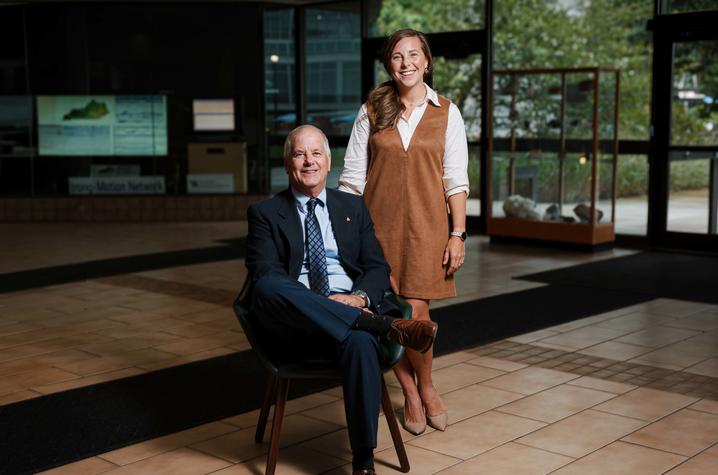
Long before Jack Groppo, Ph.D., a mining engineer, and his daughter, Martha Groppo, Ph.D., a historian, shared a classroom, they shared a philosophy around the family dinner table.
That philosophy was to “unearth worth” — to ask big questions, stay curious and find value in connections, even when it isn’t obvious.
Those lifelong curiosities are now empowering students across two Kentucky campuses. This is the shared story of Jack and Martha.
It all started four decades ago.
Jack joined the University of Kentucky in the mid-1980s, and through dozens of initiatives over the years in the labs at the University of Kentucky Center for Applied Energy Research (UK CAER), Jack consistently unearthed worth — finding value where others may have missed it, turning industrial waste from coal and other materials into valuable resources. Jack has used microalgae to capture carbon dioxide, using the leftover algae to create bioplastics. He has started an electronics recycling research program, extracting the nonrenewable metals that our computers and phones require. He even launched a small corporation with a few of his students that recycles the materials from used solar panels.
“Whether coal, copper or any mineral that we mine, the mineral value itself is quite small,” said Jack, who is also a professor of mining engineering in the UK Stanley and Karen Pigman College of Engineering. “In fact, what we mine now is what we used to throw away generations ago. As the world’s population uses all of our rich deposits, I am trying to not only recover the waste but going one step further by putting the waste to work.”
For decades now, Jack has lived this philosophy both at work and at home. Jack, often covered in coal dust, would bring mineral samples from the lab and tell the family stories of his discoveries in mining engineering. His three daughters would often accompany him to mining conferences.
“They’ve been dragged to mines all over the world since they were in diapers,” Jack said.
Martha, Jack’s middle daughter, recounts her childhood fondly, with mining trips, dinner table conversations and scientific research environments shaping her mind and heart — and strengthening the bond with her family of five.
“Dad and I are close. We’re a close family,” Martha said. “I was raised by mining engineers, and I grew up at a dinner table that was constantly discussing mineral processing. We sold Girl Scout Cookies at CAER, and I loved looking at all the instruments in the labs. Dad shared his career with us, and it taught us how mining connects with everything really — humanity, culture and history.”
The Groppos saw the value in these economic, political and cultural connections. They encouraged their daughters to speak openly and ask big questions. They cultivated and reinforced curiosity. They understood that science can tell us what something is and how something works, while history and culture can tell us why it matters.
By unearthing worth in conversations, they built a foundation for innovation, with each of the Groppo daughters finding value on their different paths. Martha’s path led her to the field of history — a journey through academia — where she would eventually stand side by side with her father.
Jack and Martha's journey into teaching together
Martha earned her undergraduate degrees from UK in history and journalism as a Gaines fellow and participated in the honors program. Jack encouraged her to leave home to keep pursuing her research and teaching.
“I told her she had a gift for teaching,” Jack said. “And in an area that’s as competitive as history, she needed to get the very best credentials. I just said, ‘Well, you need to go to Princeton. You just need to do that.’”
Martha took her dad’s advice and went on to become the second Dr. Groppo, as she completed both a master’s degree and doctorate in history at Princeton University as a British historian. Her father’s support never waned.
“As I delved into studying history and came home from grad school or checked in from archives around the world, I would share with dad what my research was like and what I was learning about,” Martha said. “He even came and met me on an archival research trip in Newfoundland.”
Meanwhile, Jack continued his own journey. While he was pushing innovation in the CAER mining laboratory, he was blazing his own path in the classroom, making the transition from research to teaching, and doing so with flying colors. Jack was a natural teacher.
Martha was able to see it as she audited his popular Power Generation Technologies class during her undergraduate years, a class Jack co-founded with CAER director Rodney Andrews, Ph.D.
“I was so proud sitting in his classroom,” Martha said. “I was just sitting in the back row. I didn’t get a grade. I just went and listened to how he was doing it because I wanted to know. He was just more engaging than most professors, and seeing the students connect and respond was captivating.”
Jack had never been taught an official pedagogy. He just brought his research experience, and most importantly, his waste-to-work philosophy, to the classroom. He found value in connecting teaching to his research.
“I don’t have any formal teacher training. I’m still not sure what I’m doing,” Jack said. “I have always taught the way I wanted to be taught.”
His approach clearly resonated. In 2016, after almost a decade of lecturing, Jack was officially hired as a tenure-track professor, an uncommon experience for lifelong mining processing researchers. Martha helped him assemble his tenure packet.
A decade later, tenured and more experienced, Jack is still making complex subjects like resource mining interesting and accessible, bringing his real-world experience as a researcher into the classroom. He has received several teaching awards from UK including the Alumni Great Teacher award in 2022 and the Provost Outstanding Teaching Award in 2024.
Like father, like daughter
While earning her doctorate, Martha continued to develop her skills, learning pedagogical techniques from Princeton. She often shared these teaching methods with Jack back home.
“Dad taught me a lot of what I know about teaching,” Martha said, “but then I would come home on visits from graduate school and ask him, ‘Hey, I learned this thing at the teaching center at Princeton. Have you tried this in your classroom?’ We shared what we learned from each other, and it was a bit of a precursor of what was to come."
Throughout graduate school, Martha’s goal was to return to Kentucky to teach. After a postdoctoral fellowship at Emory University and a visiting assistant professorship at Berea College, she joined Eastern Kentucky University (EKU) in 2022. Today, she teaches courses at EKU that explore rural and frontier history, the history of medicine and science, and modern European and British history. The interdisciplinary perspective that Martha learned at the Groppo dinner table continued to guide her pedagogy. Soon, that pedagogy would be guiding students across two Kentucky campuses.
Melding of minerals and mankind
Around 2021, Jack had observed that students in his mining engineering courses were asking broader questions in the classroom about resource extraction, and many of these had historical and political answers. Mining engineering had a vital human story behind it all, and Jack needed an expert to help him tell the story.
Luckily, he knew a historian.
Martha became a staple guest lecturer in one of Jack’s classes, using her expertise in the history of imperialism and colonization to explain the political and economic dynamics of the “blood diamond” extractions in the late 19th and early 20th centuries. Immediately, Jack knew this was something special.
“When she taught in my class, I realized that, oh my goodness, she’s really good at this,” Jack said. “The perspective she brought was invaluable to the students. I can’t do it. I’ve tried to lecture off her notes and that’s not something I ever want to do again, because I do serious injustice to it. So then we started doing it for the [Democratic Republic of the Congo] DRC, and she did an excellent job with that. That’s when we decided it needs to be more comprehensive.”
Martha helped Jack create curriculum for a new mining engineering course, but one that was more interdisciplinary.
“The goal was not to have a course for mining engineers,” Jack said. “The goal was to have a course to spread the importance of minerals to the general academic community. I could do the technical part, but Martha was vital in helping me make it fit into UK’s global dynamics core requirement.”
Jack’s class, Conflict Minerals: Global Supply and Sustainability, has a capacity of about 60 students and has included students from 18 different majors from across the university. It deals with our current technological world and the very scarce commodities that power our smartphones, tablets and computers. Often, these are found in geographically and politically challenged areas. The class dives deep into these issues, and student reviews have been excellent.
“I realized there was such a broad appeal. Students would stay around after class, ask questions and follow me back to my office,” Jack said. “There was a genuine interest in this area, and it was just too good a story to keep in my little classroom.”
Soon, interest in the topic moved south with Martha to EKU. Martha and Jack again collaborated to create a sister course there. Honors classes at EKU are typically interdisciplinary by design, and with the support of EKU Honors Program Director David Coleman, Martha developed “Minerals & Conflict in History.” The course explores how minerals have fueled empires, conflicts, technological advances and global supply chains while also inviting students to debate the consequences of their consumption. Jack is a regular speaker in the class, switching classrooms with his daughter and closing the circuit, so to speak.
“I emphasize to students that it is really important to understand the history and political impact of something like a mineral,” Martha said. “But it’s impossible for them to do that adequately if they don’t understand something about the technical side. That’s where dad comes in. When we have that technical context provided by dad about what a mineral is, students can better appreciate and understand why it has been so historically significant.”
EKU students have praised the course.
“I can confidently say it is the most important class that I have ever taken,” said EKU psychology major Autumn Brock. “Martha Groppo made the class extremely personal, and it’s a class that I carry with me every day. It informs how I think about everything: the iPhone that I hold in my hand, knowing that the cobalt that is used to power it was mined in the harsh conditions that the miners of the Democratic Republic of the Congo are forced to work in.”
The value of interdisciplinary education
These courses were decades in the making. Both Martha and Jack have found a new camaraderie now, not only as father and daughter, but as colleagues — seeing value in wasted materials, seeing value in their students and seeing value in interdisciplinary conversations. More than anything, father and daughter have learned to see more value in each other.
“I’ve always been proud of my dad, and now I get to teach with him — so that’s been really meaningful,” Martha said. “And for our students, it’s valuable to think across disciplines, not silo yourself, not be intimidated by the sciences if you love the liberal arts and vice versa. These things are artificial disciplinary boundaries that we have put up. It’s all knowledge that makes the world more interesting and useful.”
“It’s really important to do things like this because it’s not a traditional teaching model,” Jack said. “It’s a little bit of effort on our part, but it serves the students — which is the goal. I think it enriches their learning experience. And clearly, it works. I would hope that more people would consider doing something like this. We don’t need to have experts at all universities in all things. We can trade places. And I think that just makes way more sense. It’s actually kind of fun.”
As Jack gets closer to retirement and Martha’s career continues to unfold, the courses they have built together reflect their enduring relationship. The strength of their courses undoubtedly comes from the strength of the Groppo family. Dinner table conversations that began years ago formed a Groppo philosophy — unearthing worth — that will continue to shape students for years to come.
“This past year, dad and I were out and about when we heard someone say, ‘Hey, Dr. Groppo!’ We both turned around,” Martha said. “It was a student from Conflict Minerals, and we all had a chuckle. I’m proud to be ‘the other Dr. Groppo’ now, and I think part of me will always think of my dad when I hear those words spoken.”

