Chellgren Center celebrates 20 years of undergraduate excellence at UK
Twenty years ago, University of Kentucky alumnus Paul W. Chellgren had a vision for undergraduate education at UK: create opportunities for students and faculty to learn across disciplines, pursue ambitious ideas and extend learning far beyond the classroom.
“UK needed something really special to focus on excellence in undergraduate education,” Chellgren said while reflecting on that vision during the center’s 10th anniversary celebration in 2016.
That vision became the Chellgren Center for Undergraduate Excellence. Established through a gift from Chellgren and his family, matched by the state to create a $4.5 million endowment, the center was founded with an ambitious aspiration: to help UK become nationally recognized as a beacon of undergraduate excellence.
This October, the center will mark a 20-year, 20-class milestone. Over those two decades, its reach has extended across every college at UK, engaging 655 students and more than 400 faculty members.
Through its student and faculty programs, the Chellgren Center supports undergraduate research and creative scholarship, faculty mentorship, experiential learning and innovation in teaching.
A cornerstone of that work has been the Chellgren Student Fellows Program, which brings together sophomores from majors across UK for faculty-mentored research and opportunities that broaden their learning beyond their primary fields of study.
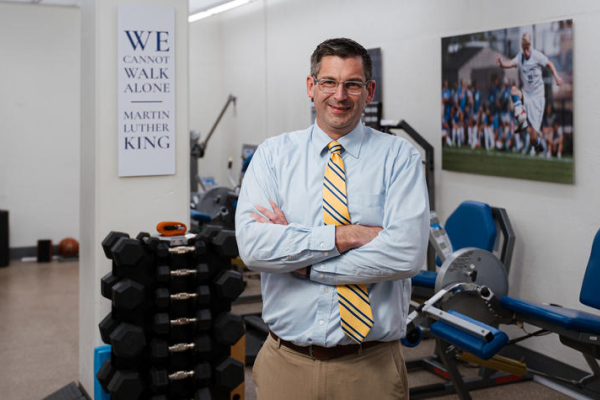
For Josiah Hanna, a 2011 Chellgren Student Fellow, that interdisciplinary approach changed the way he understood academic excellence.
As an engineering student from 2010-14, Hanna spent much of his academic life alongside other engineering students, learning to approach problems from a technical perspective. Through Chellgren, he encountered students and faculty whose disciplines, skills and approaches were different from his own.
“Chellgren broadened my understanding of what scholarly excellence looked like in other fields,” Hanna said. “I believe this has given me a better understanding of the skillsets that different people can bring to the table when confronting real world challenges.”
The experience also made Hanna more intentional about his goals and how he spent his time at UK. He went on to earn several nationally competitive awards and pursue doctoral studies. Today, he is a professor at the University of Wisconsin-Madison and serves on the Chellgren Center’s board.
Hanna said the community he found through Chellgren is part of what has kept him connected to the center.
“It’s remarkable how Chellgren staff have made the program a real community,” he said.
Lynn Hiler, the Chellgren Center’s chief administrative officer, has watched that community take shape from the beginning. She began working with the committee responsible for developing the student fellows program in 2005, initially expecting her role to center largely on logistics.
“It’s more than I could have ever imagined,” Hiler said. “I thought my involvement with the Chellows program was just going to be a glorified paper pusher, but instead I have had experiences and memories of my own.”
Hiler has since met every student fellow to participate in the program. She also inadvertently gave them the name that has become part of the center’s identity.
Around 2010, while talking with a colleague, Hiler tried to say “Chellgren Fellow.” Instead, she said “Chellow.”
The name stuck.
Expanding the Chellgren experience
While the emphasis on research, mentorship and community has endured, the Chellgren experience has continued to evolve.
In 2017, Paul Chellgren and his wife, Deborah, made an additional gift to support the center’s work. In recent years, the Chellgren Center has continued to expand opportunities for both students and faculty, including several initiatives developed under the leadership of Isabel Escobar, Ph.D., Chellgren Endowed Chair and center director. For students, that has included an annual trip to Washington, D.C., designed in part to build a stronger cohort among Chellows, and a biennial trip to England focused on professional development. In Washington, students visit institutions including Congress and the National Mall; in England, they visit University College at the University of Oxford — Paul Chellgren’s alma mater — and meet Gates Cambridge Scholars at the University of Cambridge.
“Seeing it up close, rather than just hearing about it, is the point,” Escobar said. “We want students to reach the conclusion, ‘I could do that,’ as they’re making decisions about research, national fellowships or where their degree could take them.”
The center has also expanded its investment in the faculty who shape the undergraduate experience.
Under Escobar’s leadership, the Chellgren Center Faculty Fellows Program has grown to provide competitive grants of up to $4,000 for UK faculty to develop new undergraduate courses and multidisciplinary projects and participate in a professional learning community focused on educational innovation.
Together with the Chellgren Center’s endowed professorships, the Faculty Fellows Program extends that investment across the undergraduate experience by supporting the faculty, courses and collaborations that shape how UK students learn.
Different generations, a shared experience
For brothers Usman and Omar Hamid, who became Chellows seven years apart, their experiences offer a glimpse at both what has changed and what has endured.
Usman entered the program as a sophomore in 2017, drawn by its emphasis on faculty-mentored research. Like Hanna, he found an opportunity to step outside the academic circles he encountered through his pre-med coursework and connect with students and faculty across disciplines.
The program also gave him opportunities to present research and develop professional skills that later helped prepare him for medical school. Today, Usman is a resident physician.
Seven years later, his younger brother followed a familiar path.
“I remember when I was in middle school, my older brother used to wear T-shirts that mentioned the Chellgren Center,” Omar said. “I never actually knew what the Chellgren Center offered for students until I got more involved in research and came to UK.”
Omar joined the program during the 2024-25 academic year, also drawn by research. His experience reflects a Chellgren Center that has expanded its experiential learning, professional development and student-led opportunities while maintaining faculty mentorship at its foundation.
Through the Chellgren Center, Omar encountered research across fields ranging from medicine and engineering to architecture, political science and business. He also connected with UK’s Office of Nationally Competitive Awards and received support while pursuing a Goldwater Scholarship.
For all that changed in the seven years between the brothers’ experiences, Usman said the foundation remained familiar.
“The biggest thing that has remained consistent is the emphasis on faculty-mentored research and presenting those findings,” he said.
For Omar, those opportunities have been made more meaningful by the people he has met along the way.
“The Chellgren program has connected me with so many mentors, and so many people willing to discuss their professional careers and opportunities,” he said. “The Chellgren program has been one of my favorite experiences at UK, and I hope it is the same for others.”
Building on 20 years
Across 20 classes, Chellgren student fellows have gone on to earn some of the nation’s most prestigious academic honors.
Hadeel Abdallah, a 2016 Chellgren Student Fellow, was named a Truman Scholar in 2018 and became UK’s first Rhodes Scholar since 1955 the following year. Chellgren alum Grace Trimble was named a Truman Scholar in 2014, and 2017 fellow Chimene Ntakarutimana received a Marshall Scholarship in 2021.
But the center’s impact is not measured by awards alone.
It is also reflected in how the aspirations Chellgren articulated two decades ago have taken shape: students crossing disciplinary boundaries, building relationships with faculty mentors, presenting original research and encountering opportunities they may not previously have imagined for themselves.
As the center enters its next chapter, Escobar said alumni engagement will become an increasing focus, strengthening a community now spanning 20 classes.
“My hope is to continue to give students access to diverse resources and dedicated support services that empower them to achieve their academic and personal ambitions,” she said.
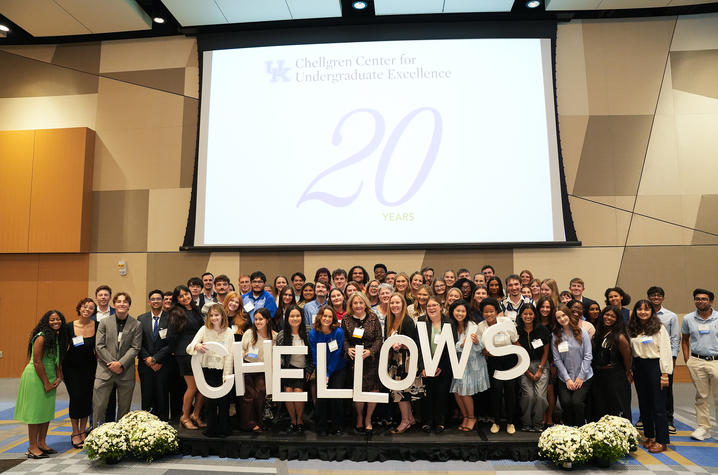
That community came together last week at the Gatton Student Center for a reunion celebrating the Chellgren Center’s 20th anniversary.
For Hiler, who has met every Chellow to come through the program, 20 years is difficult to comprehend.
“I can’t believe 20 years have flown by, but I have been blessed to meet every single Chellow that has been a part of our program,” she said. “I can’t thank the Chellgren family enough for the opportunities our students have.”