Research awards exceed $500 million, power UK mission to advance Kentucky
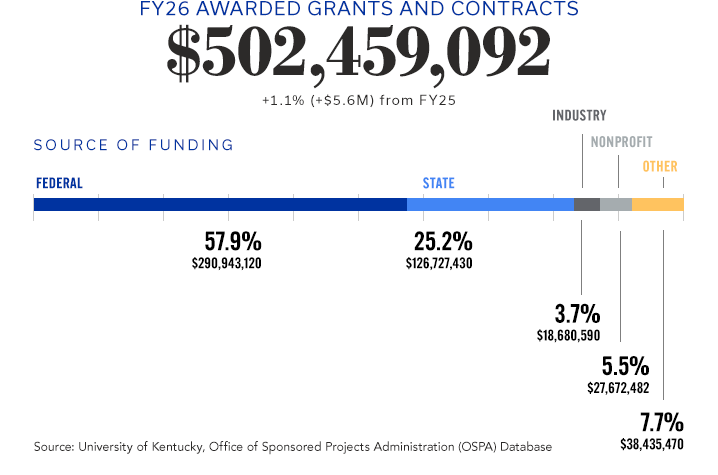
For the first time in University of Kentucky history, research awards have surpassed $500 million. This achievement marks five consecutive years of growth. UK investigators received $502.5 million in extramural grants and contracts to support their research in fiscal year (FY) 2026.
“Research is essential to our promise of advancing Kentucky. Through discovery and innovation, we partner with industry to solve problems, train our students for tomorrow’s workforce and serve Kentucky families by bringing new treatments and care that heals,” said UK President Eli Capilouto. “This achievement is a testament to what is made possible when our people can leverage the full strength of a collaborative, mission-driven research institution created to ensure a tomorrow that is healthier, wealthier and wiser than today.”
“As we reflect on this record-breaking year, we extend our deepest gratitude to every member of the research community whose dedication, resilience and unwavering commitment made this possible,” said Ilhem Messaoudi, Ph.D., acting vice president for research. “This milestone was accomplished under pressure from all sides and earned through shared determination to move forward. Our community’s collective strength can accomplish remarkable things.”
UK researchers received 1,831 awards, with 832 principal investigators supported by 598 sponsors in FY26.
Federal awards totaled $290.9 million (57.9% of UK’s total research funding) and supported investigators across the breadth of UK research.
- National Institutes of Health (NIH) grants increased 21.8% (from $130.2 million in FY25 to $158.6 million in FY26).
- U.S. National Science Foundation (NSF) awards increased 47.8% (from $25.2 million in FY25 to $37.3 million in FY26).
State awards totaled $126.7 million, industry awards were $18.7 million and nonprofit awards were $27.7 million in FY26.
Research highlights:
- With prestigious NIH Centers of Biomedical Research Excellence (COBRE) grants, UK is mentoring the next generation of researchers and building infrastructure and innovation in translational chemistry and diabetes prevention.
- In collaboration with NASA, engineering researchers measured gas movement in heat shields and developed advanced imaging methods to ensure crew safety for Artemis II.
- The Center for Applied Energy Research, in partnership with the state, identified corn oil as the lowest-risk, most viable pathway for sustainable aviation fuel manufacturing in Kentucky.
- Two years into the Kentucky Corn Growers Association study, UK Research and Education Center scientists have proven the viability of drone fungicide application and are optimizing spray systems to effectively manage diseases in Kentucky cornfields.
- With funding from the NIH and the Global Lyme Alliance, UK researchers are fighting Lyme disease by turning the bacteria’s own internal systems against it.
- Through the Raising Hope program, administered by the Kentucky Department of Agriculture, UK College of Nursing students are bringing lifesaving preventive screenings and care to rural farmers.
- With NIH funding, UK researchers built RADOR-KY, a surveillance system delivering near-real-time opioid overdose data for all 120 Kentucky counties to health departments, community organizations and policymakers.
- With NIH and Alzheimer’s Association funding, UK researchers revealed a distinct immune “fingerprint” in the blood of patients who develop amyloid-related imaging abnormalities after Alzheimer’s treatment with lecanemab.
- With funding from the Kentucky Cabinet for Health and Family Services and National Cancer Institute, every newly diagnosed pediatric cancer patient at Golisano Children’s at UK has access to screening for 150 inherited cancer genes, enabling an individualized care plan for the child and their family.
- UK received a record eight NSF CAREER awards for a broad range of research, including workforce development and sustainable pipelines for U.S. water systems; analyzing massive datasets and building a skilled workforce to accelerate cosmology and energy science discoveries; developing safety systems to help self-driving vehicles and drones work together, creating anti-tracking and robocall-free architecture, and exploring new approaches to computer-aided design education.
To learn more about innovative UK research that impacts Kentucky and beyond, visit research.uky.edu/news. For more UK Research data, visit the Stats & Rankings page.