
Robinson wins UK’s 6th Karen Wetterhahn Memorial Award
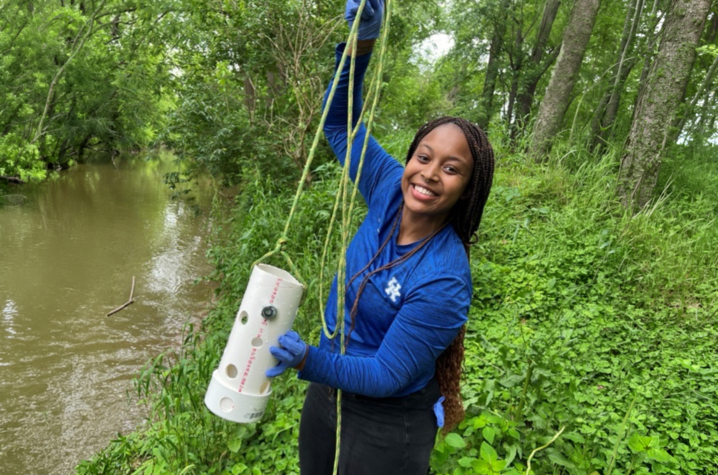
Ariel Robinson, a Ph.D. candidate in civil engineering in the University of Kentucky Stanley and Karen Pigman College of Engineering, has been named the recipient of the 28th annual Karen Wetterhahn Memorial Award.
The national honor, presented by the National Institute of Environmental Health Sciences (NIEHS) Superfund Research Program (SRP), recognizes one outstanding graduate student or postdoctoral researcher nationwide who demonstrates scientific excellence, mentorship and service to the community. Robinson, a doctoral trainee within the UK Superfund Research Center (UKSRC) and a previous Lighthouse Beacon Foundation Graduate Fellow, is the sixth UK researcher to receive this recognition since 2012.
UK’s track record highlights its leadership among more than 25 universities participating in SRP-funded research centers across the country. Previous UK winners have gone on to hold prominent roles in the scientific community, including positions in the National Institutes of Health director’s office and leading decontamination protocols for NASA’s Artemis II mission.
“Ariel receiving this award demonstrates the strength of our center, which is powered by our trainees,” said Kelly G. Pennell, Ph.D., director of the UKSRC and the Earl Parker Robinson Chair of Sustainability and the Environment. “Ariel’s professionalism, collaboration and deep commitment to scientific excellence have earned her the affectionate nickname ‘goal-digger’ within our research group. She also understands that moving science forward requires building relationships, broadening participation and ensuring that research translates into actionable outcomes.”
Protecting communities
Robinson’s research focuses on per- and polyfluoroalkyl substances, commonly known as PFAS or “forever chemicals.” These synthetic compounds have been widely used for decades in industrial and consumer products, including nonstick cookware, waterproof clothing and firefighting foam. Because PFAS resist natural degradation, they persist in soil and water for long periods, posing potential health risks such as immune system suppression, chronic diseases and certain cancers.
“Many communities do not have the resources to test every location that is potentially contaminated,” Robinson said. “To help address this challenge, I develop tools that use existing environmental and industrial information to predict where PFAS contamination is most likely to occur. These tools help industries, government agencies and communities decide where limited resources should be focused first.”
In addition to site prioritization, Robinson investigates vapor intrusion, a process in which chemical contaminants migrate from contaminated soil and groundwater into the indoor air of surrounding buildings. To address widespread scientific uncertainties surrounding PFAS vapor intrusion, Robinson led a project that collected and evaluated hundreds of physical and chemical measurements used by environmental risk assessors.
“Because these values often differed greatly from one source to another, we developed a framework to help decision-makers determine which information is most reliable and appropriate to use,” Robinson said. “My goal is to make complex environmental science more practical and accessible, helping communities, regulators and public health professionals make informed decisions that reduce exposure to harmful chemicals and protect human health.”
Robinson’s commitment to community-centered engineering was recently showcased at the Kentucky Water Resources Institute Annual Symposium in Lexington, where she received the award for most outstanding platform presenter. Her presentation covered the evolving regulatory landscape of PFAS, providing contextualized scientific insights tailored specifically for Kentucky stakeholders facing urgent water quality challenges.
“My training at the University of Kentucky has taught me that solving environmental challenges requires much more than generating data in a laboratory,” Robinson said. “It requires building partnerships with communities, listening to stakeholder concerns and ensuring that scientific discoveries can be translated into action.”
Through her interdisciplinary work alongside engineers, environmental chemists, data scientists and public health officials, Robinson has gained firsthand insight into the real-world economic, technical and regulatory constraints local governments encounter.
“My education and research experiences have prepared me to bridge the gap between scientific discovery and practical action,” Robinson said. “They have shown me that engineering research can have the greatest impact when it is developed in partnership with the communities it is intended to serve.”
Robinson attributes UK’s sustained national success in the Wetterhahn Award competition to the deeply collaborative culture fostered within the UKSRC.
“UKSRC has been bringing together people from different fields for nearly three decades, and that environment teaches graduate students how to work across disciplines, build lasting relationships and tackle complex problems as a team,” Robinson said. “As trainees, we know that when we need support, we can reach across colleges and departments at UK, and even beyond the university through the broader NIEHS Superfund Research Program network.”
This supportive atmosphere is reinforced by mentorship that encourages trainees to expand their professional horizons through national conference presentations, inter-institutional visits and broader scientific networking.
“I would especially like to recognize my advisor, Dr. Kelly G. Pennell, whose mentorship has been instrumental in my academic journey,” Robinson said. “Dr. Pennell has challenged me to think critically, approach problems from multiple perspectives and never stop asking ‘why.’ Her support has given me the confidence to pursue ambitious research questions, engage with communities and stakeholders, and develop as both a scientist and a leader.
“One of the most important lessons I have learned is that growth often comes from being willing to sit with uncertainty and pursue opportunities that feel intimidating at first,” Robinson said. “Their encouragement to remain curious, embrace discomfort as part of growth and approach challenges with confidence has prepared me for opportunities like this and continues to shape the kind of researcher I hope to become.”
Paying it forward
Beyond her lab research, Robinson has developed strong leadership skills through extensive campus involvement. Having earned her bachelor’s degree at UK in 2021, she has served as a mentor for the UK National Society of Black Engineers, treasurer of the UK Black Graduate and Professional Student Association, a teaching assistant for first-year engineering students and a graduate student leader within the UKSRC.
In the local Lexington community, Robinson serves as the engineering director for Nerd Squad, a nonprofit organization that runs hands-on STEM clubs for young girls.
“My passion for empowering young girls in STEM has been one of the most meaningful parts of my personal and professional development,” Robinson said. “As a woman in engineering, I understand how powerful it can be for young students to see someone who looks like them succeeding in STEM. This commitment enriches my identity as an engineer because it reminds me that our impact extends far beyond experiments in the laboratory or technical solutions on paper. Because of the opportunities that others invested in me, I feel a responsibility to give back and help create those same experiences for the next generation. Just as others uplifted and inspired me when I was young, I want to help open doors for future scientists and engineers.”
Wetterhahn’s legacy
The Karen Wetterhahn Memorial Award was established by the SRP to honor the memory of Karen E. Wetterhahn, Ph.D., a professor of chemistry and renowned expert in heavy metal toxicity at Dartmouth College who passed away in 1997. Wetterhahn was a pioneer in interdisciplinary life sciences research and co-founded Dartmouth’s Women in Science Project (WISP) to increase female participation in mathematics, science and engineering.
As the 2026 award recipient, Robinson was invited to present a 35-minute seminar on her researchat the 2026 SRP Annual Grant Recipient Meeting, Oct. 26-28, in Portland, Oregon, alongside institute leadership. She will also deliver a research presentation at NIEHS headquarters.
Driven by her love for teaching and communicating science, Robinson plans to pursue a career as a university professor after completing her doctorate, using her platform at UK as a springboard to educate, mentor and inspire future generations of engineers.
Research reported in this publication was supported by the National Institute of Environmental Health Sciences of the National Institutes of Health under Award Numbers P42ES007380 and P30ES026529. Research reported in this publication was supported by the National Library of Medicine of the National Institutes of Health under Award Number G08LM013185. The content is solely the responsibility of the authors and does not necessarily represent the official views of the National Institutes of Health.
Research reported in this publication was supported by the U.S. National Science Foundation under Award Number 1452800. The opinions, findings, and conclusions or recommendations expressed are those of the author(s) and do not necessarily reflect the views of the U.S. National Science Foundation.

