UK aerospace engineering researcher earns NASA Early Career Faculty Award
Have you ever wondered, what happens when a spacecraft plunges through a planet’s atmosphere?
Dan Fries knows it encounters searing temperatures, powerful shock waves and chemically reactive gases — conditions that can push even the most advanced heat shields to their limits.
Now, the University of Kentucky researcher is developing new technology to help scientists better understand these extreme conditions — and ultimately design spacecraft that can better withstand them.
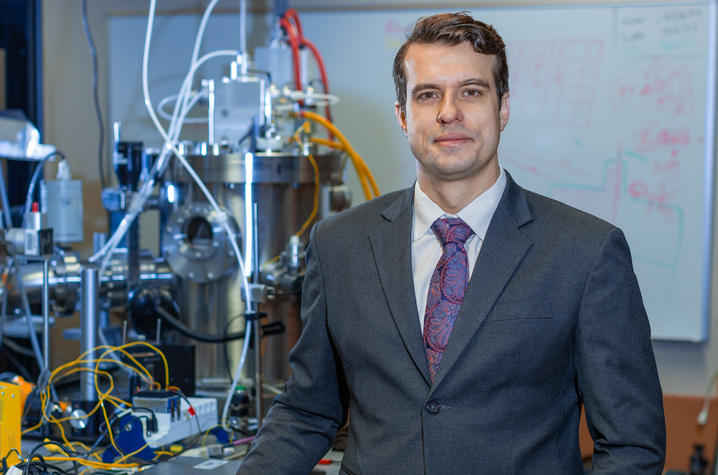
Fries, Ph.D., assistant professor of mechanical and aerospace engineering in the UK Stanley and Karen Pigman College of Engineering, has received a NASA Early Career Faculty Award to support his three-year research project, “Multiplexed Polarization Spectroscopy for Single-Shot Multi-Species Diagnostics in High-Enthalpy Flows.”
Through the project, Fries will develop a laser-based measurement system to capture detailed information about multiple chemical species and thermal conditions in plasma flows.
The research comes as interest in hypersonic flight, planetary exploration and next-generation spacecraft continues to grow.
“Hypersonics has seen a resurgence of interest — allowing new opportunities to develop advanced technologies for atmospheric reentry and high-speed transportation,” Fries said. “Our proposed technique focuses precisely on the region where the flow meets the vehicle, providing spatially resolved information about molecular and atomic species, as well as different energy modes, in an extremely hostile environment.”
Atmospheric entry is one of the most demanding phases of a space mission.
As a spacecraft travels through the atmosphere at extremely high speeds, its motion creates enormous amounts of heat. A powerful shock wave forms in front of the vehicle, creating a superheated layer of gas and plasma around it. In this extreme environment, intense radiation and chemical reactions can affect the spacecraft’s outer surface.
Fries’ technology will give NASA and the broader aerospace community a clearer, real-time view of what happens in this superheated gas as a spacecraft enters an atmosphere.
“When a spacecraft enters Earth’s atmosphere, for example, it can travel at speeds of about 8 kilometers per second (about 5 miles per second), or more, and must safely dissipate an enormous amount of energy as it slows down,” Fries said. “Designing a successful reentry vehicle means ensuring the spacecraft — and everything it carries — can withstand this incredibly violent portion of the journey. That requires thermal protection systems that can perform reliably.”
Fries’ technology will provide detailed measurements of the hot gas and plasma surrounding a spacecraft during atmospheric entry.
Researchers can use the data to improve computational models and help engineers design heat shields more efficiently and reliably.
“The goal of this project is to enable high-fidelity measurements, especially near the plasma-material interface, under such extreme conditions,” Fries said. “This would provide data that is currently not available, leading to more accurate predictions of heat transfer and chemical reactions and, ultimately, shorter design cycles, lower costs and higher reliability.”
The project — in collaboration with researchers at the University of Wisconsin-Madison and the University of Stuttgart — will also leverage UK’s HELMUT and KASPAR plasma wind tunnel facilities. They are internationally recognized research assets that allow scientists to recreate the extreme conditions associated with hypersonic flight and atmospheric entry.
“Together, we have everything we need to fully develop new diagnostics, test materials and cover a wide range of plasma compositions, flow velocities and pressures,” Fries said.
Additionally, the award will support the education and training of two doctoral students in aerospace engineering — giving them hands-on experience with cutting-edge research.
“This project gives students a rare opportunity to work on research that could help shape the future of space exploration,” Fries said. “They’ll work alongside NASA researchers, gain firsthand experience tackling some of the biggest challenges in space access and see how their work can contribute to what comes next.”
NASA’s Early Career Faculty program awards grants to accredited U.S. universities on behalf of outstanding faculty researchers pursuing high-impact space technology research. The competitive program encourages early-career investigators to explore novel ideas and technologies that can make space exploration more effective, affordable and sustainable.
The material is based upon work supported by NASA under award No 80NSSC26K0694. Any opinions, findings, and conclusions or recommendations expressed in this material are those of the author(s) and do not necessarily reflect the views of the National Aeronautics and Space Administration.