UK aerospace students collect eclipse data for NASA in 'Land of Fire and Ice'
When Iceland experienced a rare total solar eclipse last month — marking the country's first total solar eclipse since 1954 and the first to cross the western region since 1433 — a team of University of Kentucky student researchers were there to measure how Earth’s atmosphere responded to it.
Five aerospace students from the Stanley and Karen Pigman College of Engineering, including undergraduate, graduate and one recent graduate, traveled to Mosfellsbær, Iceland as part of the NASA-supported Nationwide Eclipse Ballooning Project (NEBP).
UK was one of five university teams selected for the 2026 NEBP campaign.
Based on the project’s research goals and environmental requirements, the UK and University of Idaho atmospheric science teams conducted fieldwork in Iceland. The remaining three engineering teams completed their research activities in Spain.
The UK team was led by Sean Bailey, Ph.D., professor in the Department of Mechanical and Aerospace Engineering and one of the atmospheric science leads for NEBP.
While Bailey advised students on campaign planning, scientific objectives and payload deployment, the project was designed so that field operations, data collections and individual experiments were fully driven by the students.
“The students really took ownership of this project and were key to its success,” Bailey said. “They had been preparing for months for this trip, learning how to operate all the systems involved, training on the data analysis, and learning about the project’s scientific objectives.”
A rare natural experiment
The UK team’s research focused on using weather balloons, meteorological masts and drones to measure the planetary boundary layer — the lowest part of the atmosphere that touches the ground and feels the direct effects of the Earth's surface.
The thickness and behavior of this layer are influenced by conditions such as surface temperature and moisture. During the day, solar heating causes turbulence and mixing in the atmosphere. When the surface cools, that mixing decreases and the boundary layer can become shallower.
A total solar eclipse creates a rare natural experiment. As the Moon blocks the sun, solar heating decreases dramatically in a matter of minutes — allowing scientists to observe how the atmosphere responds to a sudden transition from daylight toward nighttime-like conditions.
Previous campaigns conducted during the October 2023 and April 2024 eclipses were able to link the boundary layer response to atmospheric behavior at the Earth’s surface. The Iceland campaign offered researchers a new environment in which to investigate the phenomenon.
As Iceland experiences exceptionally long days and short nights in August, nighttime influences on the atmosphere are different from those present during the previous eclipse campaigns.
Researchers wanted to know whether the boundary layer would be more resistant to collapse in Iceland because the atmosphere had not experienced the same degree of nighttime cooling.
“In Iceland, that response was very different, due to cloudy conditions which insulated the Earth’s surface from the effects of the eclipse,” said Bailey. “Our initial results suggest that turbulence produced at the Earth’s surface, which was damped in our measurements in the US, may have been amplified by the eclipse in Iceland.”
High-flying field work
The UK team began preparing for the campaign in March, months before traveling to Iceland.
Working with the other NEBP teams and experts, students helped design the eclipse campaign around the project's atmospheric science goals. They also conducted at least six test balloon launches to prepare for the field campaign and ensure that equipment and procedures were ready.
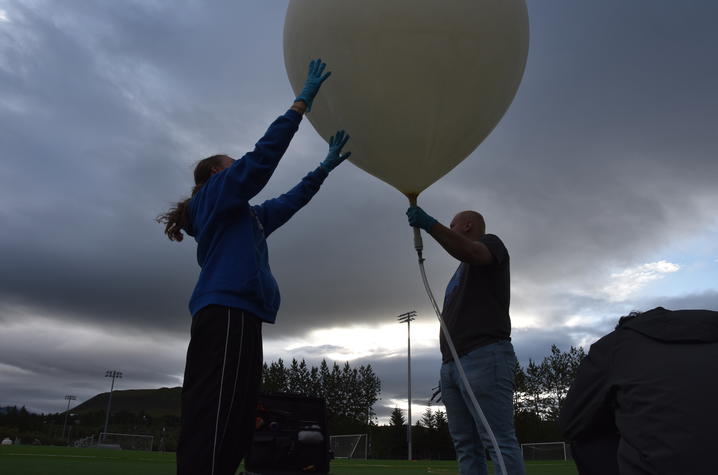
In Iceland, the team used Graw radiosondes, which are small, lightweight weather stations that are carried by high-altitude balloons, to collect atmospheric measurements. The project called for a 30 balloon flights, beginning 24 hours before the eclipse and continuing at regular intervals through six hours after eclipse totality. These measurements were complemented by meteorological measurements made by surface masts and drones, which measured the atmosphere up to 400 feet above the surface.
The repeated measurements allow researchers to create a detailed picture of the atmosphere before, during and after the eclipse and examine how quickly the planetary boundary layer responds to the sudden loss and return of sunlight.
For the students, the experience provided an opportunity to apply concepts from the classroom in an international field work.
“My favorite part was being able to collect the data myself and then come back and analyze it,” said Donovan Adams, a graduate aerospace student. “It is something very unlike traditional classroom work and has been a rewarding experience.”
The project also taught students how to work together and adapt when dealing with real-world variables.
“Beyond the analysis itself, staying adaptable when experimental difficulties arose was a major part of our success,” Adams said. “And our group did an excellent job navigating the challenges that came up.”
What’s next?
Although the eclipse campaign has concluded, the UK team's work will continue through the fall. Students will analyze the atmospheric data collected in Iceland and work with the other NEBP teams to begin preparing their findings.
Their measurements could help scientists better understand how the planetary boundary layer responds to abrupt changes in solar heating — information that can contribute to a broader understanding of atmospheric processes that that drive weather, shape climate and exchange energy with the surface.
The research also demonstrates the value of eclipses as opportunities for atmospheric scientists to conduct experiments that would otherwise be difficult to reproduce.
The UK NEBP team is already looking forward to the upcoming eclipse that will cross Spain, Gibraltar and North Africa in summer 2027.