
The ‘front door’ to change: UK’s Community Innovation Lab unveils new home
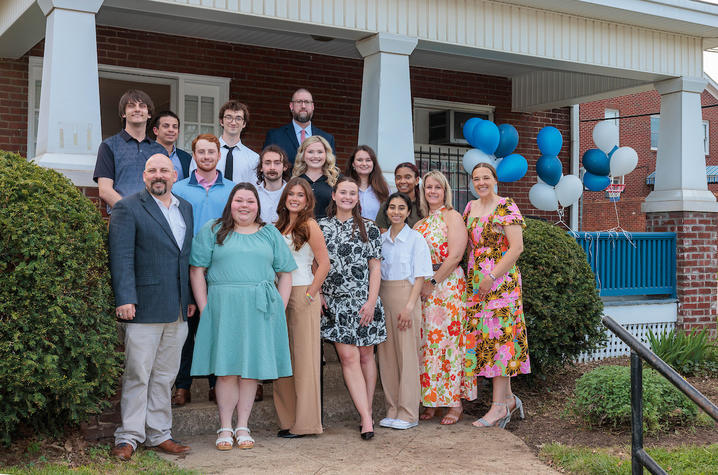
At the University of Kentucky, a unique lab is helping students find purpose beyond the classroom and giving community members a place to build meaningful partnerships.
With the opening of a new, dedicated space, the Community Innovation Lab, housed in the Martin-Gatton College of Agriculture, Food and Environment (CAFE) and UK College of Education, has found a long-awaited “front door” — a place where ideas, people and community impact converge.
On Friday, April 3, 2026, the lab officially opened its doors at its new home, located at 641 Maxwelton Ct. in Lexington.
“This institution is large,” said Bryan Hains, Ph.D., professor in the Department of Community and Leadership Development (CLD) at Martin-Gatton CAFE and lab co-director, along with Kristina Hains, Ph.D., professor in the Department of Education Leadership Studies at the College of Education. “There are 17 colleges, and over 30,000 students. Where’s the front door?”
The Community Innovation Lab is not new. In fact, it has been quietly shaping student leaders and community partnerships for over 13 years. Now, with a space of its own, the answer to “Where is the front door?” is becoming clear.
“It started off as a faculty initiative and has evolved into a student initiative,” Bryan Hains explained. “And what we do is work along and collaborate with the community to address some of the issues that they may have — or some of the innovations that they haven’t even thought of yet.”
At its core, the lab operates on a simple but powerful idea: Learning should not be confined to a classroom. Instead, students engage directly with real-world challenges, working alongside communities.
Projects have included partnerships with ONE Lexington addressing gun violence, collaborations with UK HealthCare’s Healthy Kentucky Initiative focused on health disparities, and strategic planning efforts with commodity groups.
No issue is too complex, and everyone in the community is included as part of the college’s commitment to the land-grant mission, according to Bryan Hains.
“We engage the community where they’re at and try to assist them with expertise as we learn with them,” he said. “We take the land-grant mission to heart. We do research, outreach and education, and we try to do it with the community.”
Learning beyond the classroom
For students, the lab offers something unique. Unlike traditional coursework, projects in the lab are not bound by semesters or grades. They’re ongoing, evolving and connecting with people in the community.
“It’s easy to learn about research and theory in a classroom,” Hains said. “But until you apply it, it doesn’t really solidify. And that includes failure.”
Students enter at different levels — freshman to senior — and grow through hands-on experience, often passing projects down to the next group to build and advance the project’s impact in the community.
“We take a student where they are, build their capacity…and they work on those projects longitudinally,” Hains said. “So, while one is graduating, they’re handing off the baton to the next one.”
For alumni like Gavin Cooper, who graduated in 2025 with his undergraduate degree in CLD from Martin-Gatton CAFE and participated in the Community Innovation Lab as a student, that experience proved transformative.
“As soon as I saw the work that was being done, I gravitated right to the lab,” Cooper said. “The ability to be involved in the community of Lexington was a super big attractor for me.”
Cooper worked on the ONE Lexington initiative, an experience that shaped both his academic and professional trajectory.
“Engaging with the community gave me the soft skills to be able to convey the work I was doing, and talk to people about what mattered to them,” Cooper said. “It just gave me a great toolkit to work with.”
A space to grow and be seen
For years, until opening its new facility, the lab was tucked away in a small, overlooked space on the third floor in the Garrigus Building on campus.
For CLD graduate student Macy French, the difference is profound.
“I remember the tiny, almost shoebox of a room we had. And just getting to have all of this space where we can really start to lift off and continue to make community impact, but in a much more accessible way, it means the absolute world," said French, who as an undergraduate double majored in anthropology and leadership for community education and human learning.
The new space is more than just square footage. It represents visibility, accessibility and opportunity.
“We hadn’t had that before,” Hains said. “But now we do have a front door, and I want that to be a highway of opportunities.”
That “highway” extends far beyond campus. The lab has built partnerships not only across Kentucky but also nationally and internationally, collaborating with institutions such as Purdue University and universities in Scotland.
Still, Hains said its mission remains grounded in place.
“We work here. We work in Kentucky. We work in Lexington,” Hains said. “But we can also work nationally and internationally.”
The power of an open door
If there is one idea that defines the Community Innovation Lab, it is openness — not just in philosophy, but in practice.
“We are an open door,” Hains said. “We want to work with you. We want to continue that capacity…and build that relationship collaboratively.”
That openness is reflected in the students who make up the lab. They come from many disciplines, backgrounds and academic standings, but share a common desire to work together and apply what they are learning
For French, that collaborative spirit is what makes the lab so special.
“The lab really is a family,” French said. “You get to hear so many different perspectives, and I think our biggest strength is each other.”
The opening of a new space does not change the mission of the Community Innovation Lab but amplifies it, according to Kristina Hains.
“The Community Innovation Lab provides an open door for community and university partnerships,” she said. “We strive to engage students from all majors, engaging the entire university through multidisciplinary partnerships to address community issues in the 21st century and beyond. The new education space for the lab will allow us to continue connecting with more students and collaborate with community stakeholders far into the future.”
Learn more about the Community Innovation Lab projects, people and resources by visiting communityinnovationlab.org.

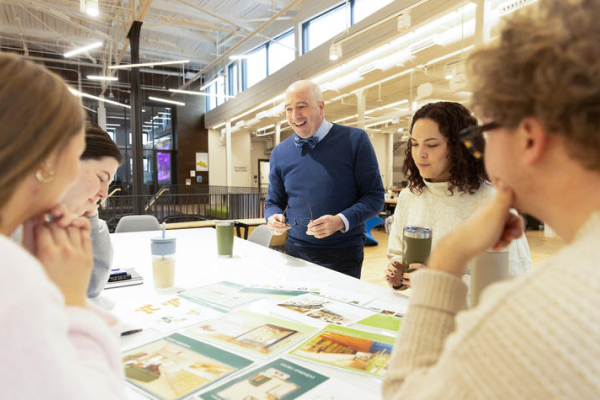

UK student presents her Community Innovation Lab project poster at open house event.
Photo by Matt Barton.

UK students presenting their Community Innovation Lab project poster at open house event.
Photo by Matt Barton.

Bryan Hains, professor and co-director of the Community Innovation lab, standing in front of the lab’s new home on 641 Maxwelton Ct. in Lexington.
Photo by Matt Barton.